

Disability insurance for lawyers is specialized income-protection coverage that pays a monthly tax-free benefit if an attorney becomes unable to perform the specific duties of their legal practice due to illness or injury. Lawyer-specific policies use a "True Own-Occupation" definition of disability, include riders for student loan protection and inflation adjustment, and provide portable coverage that follows you between firms. Premiums typically run 1% to 4% of annual gross income.
Imagine you’re three years into a promising career at a top firm, but a sudden diagnosis makes it impossible to meet the 2,000 billable hours your position demands. We know you’ve invested years of study and likely over $200,000 in tuition to build this life. It’s stressful to think that a health setback could leave you with mounting debt and no way to pay it.
This guide to disability insurance for lawyers shows you how to secure specialized own-occupation coverage. This ensures you receive benefits even if you can work in a different field, provided you cannot perform the specific duties of your legal specialty. You’ll learn how to balance the cost of premiums against the long-term benefit of income protection.
While we provide instant term life quotes without asking for your name, disability insurance is different. Because these policies are highly technical, we require your contact information to start a direct discussion. We want to act as your trusted advisor, matching you with a carrier that understands your unique risks. We’ll walk you through every jargon-filled clause to ensure your career is fully protected in 2026.
Key Takeaways
-
Protect your most valuable asset—your ability to earn—by understanding why specialized income protection is vital for attorneys with high law school debt.
-
Learn why “True Own-Occupation” coverage is the essential standard for legal professionals, ensuring you receive benefits even if you transition into a different career.
-
Identify the common pitfalls of firm-provided group plans and how individual disability insurance for lawyers provides the portability needed to protect your career wherever it leads.
-
Discover how to customize your policy with key riders like COLA and Residual Disability to maintain your lifestyle and keep pace with inflation through 2026.
-
Understand why we require a direct discussion and personal contact information upfront to provide the accurate, specialized disability quotes that your unique legal practice demands.
Table of Contents
-
Why Specialized Income Protection is Essential for Attorneys
-
The Power of "True Own-Occupation" Coverage for Legal Professionals
-
Individual vs. Group Disability Insurance: Why Your Firm’s Policy May Not Be Enough
-
How to Get an Accurate Disability Insurance Quote with LifeInsure.com
Why Specialized Income Protection is Essential for Attorneys
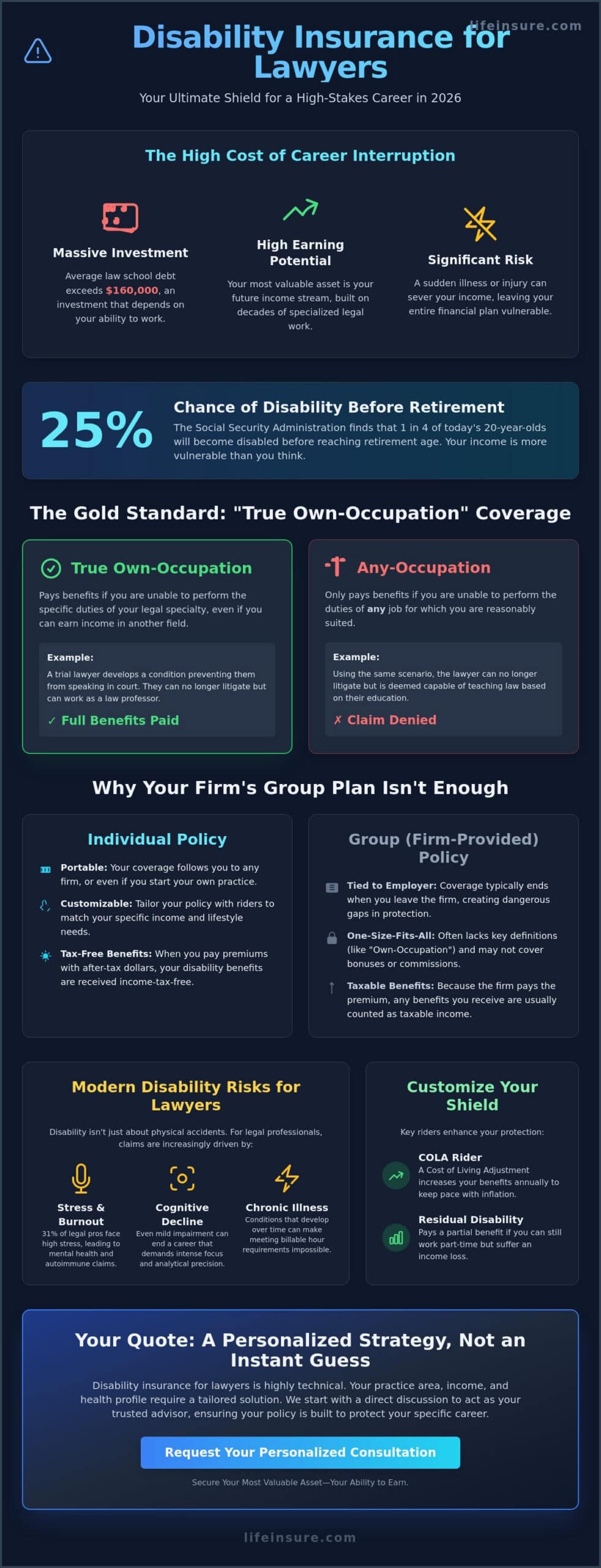
For most attorneys, your greatest asset isn’t your home or your 401(k); it’s your ability to generate income. This is especially true for those entering the field in 2026. The American Bar Association reported in 2024 that the average law school graduate carries over $160,000 in student debt. When you combine this debt with the high earning potential of a legal career, Disability insurance becomes a foundational requirement for your financial security. We see many professionals prioritize life insurance, yet the Social Security Administration notes that a 20-year-old worker has a 25 percent chance of becoming disabled before reaching retirement age.
We want to be upfront about how we help you find the right coverage. While we offer instant quotes for term life insurance without requiring personal details, disability insurance for lawyers is a more complex and personalized product. Because your specific practice area, income level, and medical history significantly affect your premiums, we require your contact information to get started. We believe a direct discussion is necessary to ensure your policy protects your specific legal niche rather than just "any job."
The High Cost of Career Interruption
The ROI of a legal education depends entirely on your ability to work consistently over a 30 to 40-year window. For a partner-track associate in 2026, human capital represents the present value of three decades of future billable hours and potential equity distributions. If an illness or injury stops those hours, you still face the reality of high-interest student loans and fixed living expenses. Specialized insurance serves as a backstop for your entire financial plan, preventing a medical crisis from leading to a total financial default.
Common Causes of Disability in the Legal Field
Disability in the legal profession is rarely about catastrophic physical accidents. Modern claims are increasingly driven by chronic illnesses and mental health challenges. A 2023 study by the International Bar Association found that high levels of stress and burnout affect 31 percent of legal professionals. These conditions can easily impede the billable-hour model, even if you are physically capable of sitting at a desk.
-
Cognitive Demands: Your job requires intense focus and analytical precision. Even mild cognitive impairment can end a specialized legal career.
-
Nuanced Definitions: We focus on "Own Occupation" definitions. This ensures you are considered disabled if you cannot perform the duties of your specific legal specialty, even if you could technically work as a clerk or teacher.
Protecting your career requires more than a generic policy. If you are ready to see how we can safeguard your future earnings, you can request your personalized disability insurance quotes through our secure process. We will work with you to find a policy that matches the unique demands of your practice.
The Power of "True Own-Occupation" Coverage for Legal Professionals
Most professionals assume their policy covers them if they can’t work. For attorneys, the definition of "work" is the most critical part of the contract. True Own-Occupation is the gold standard because it focuses on your specific duties rather than just your ability to earn a living. If you’re a litigator who loses the ability to speak clearly in court, you’re disabled under this definition. This applies even if you’re healthy enough to work as a legal consultant or law professor. Forbes explains the importance of disability insurance for high-income earners who need to protect their specialized skills from career-ending injuries or illnesses.
Don’t confuse this with "Any-Occupation" language. Any-Occ policies only pay if you’re unable to work in any field you’re reasonably suited for based on education or experience. If you can’t practice law but could work in an administrative role, an Any-Occ policy might deny your claim entirely. We focus on True Own-Occ because it ensures your lifestyle won’t collapse if you’re forced to take a different career path. It provides the financial flexibility to stay in the legal world on your own terms or exit it without losing your income floor.
True Own-Occupation vs. Modified Own-Occupation
Modified own-occupation riders are common, but they work differently from True Own-Occ. These riders pay benefits only up to the point where your new income plus the benefit equals your pre-disability earnings. True Own-Occupation is much simpler; it pays your full benefit regardless of what you earn in a new field. Specialty language is vital here. If your policy specifies "Patent Attorney" rather than just "Attorney," your protection is significantly stronger. Consider a trial lawyer who can no longer handle the 70-hour weeks and high-stress environment of the courtroom due to a cardiac condition. If they take a $115,000 role teaching law, a True Own-Occ policy pays their full disability benefit on top of that new salary.
Why Niche Expertise Matters in Policy Selection
Insurance carriers categorize legal specialties into different risk classes. A transactional attorney with a desk-based practice often receives different rate structures than a criminal defense lawyer. We’ve seen carriers adjust their views on certain legal niches based on claim data from the last five years. Because disability insurance for lawyers involves these complex definitions, we don’t offer instant online quotes for this product. We need to have a direct discussion with you to understand your specific billable hour requirements and daily tasks. This allows us to find the carrier that views your legal niche most favorably. You can request a personalized consultation with us to begin comparing your options. We’ll help you navigate the fine print so you get the exact specialty protection your career requires.
Individual vs. Group Disability Insurance: Why Your Firm’s Policy May Not Be Enough
You likely have disability coverage through your firm. Most mid- to large law firms provide group long-term disability (LTD) as a core benefit. It’s a great foundation, but relying on it alone is often a mistake for high-earning attorneys. The "Group Coverage Trap" refers to the hidden limitations in these plans. While they offer a basic safety net, they rarely account for the specific needs of a legal career in 2026. We often see lawyers who believe they are fully protected, only to find that their group plan covers less than half of their actual lifestyle expenses.
The Problem with Non-Portable Benefits
If you decide to leave your current firm, your group coverage doesn’t follow you. This lack of portability is a major risk. If you develop a health condition before securing a new policy, you might find yourself uninsurable or facing much higher premiums due to your age. Owning your own policy ensures you are protected whether you stay at your firm, move to a boutique practice, or go solo. Individual policies are guaranteed renewable and non-cancelable. This means your coverage stays exactly the same regardless of your employer; the insurance company cannot change your premiums or cancel your policy as long as you pay on time.
Tax Implications and Benefit Caps
Taxation is a significant hurdle that many lawyers overlook. When your firm pays the premiums, the IRS treats the benefits as taxable income. A policy that promises to cover 60% of your salary might only provide 40% in actual take-home pay after taxes. Many group plans also have a monthly "Benefit Cap," often set at $10,000 or $15,000. For a partner earning $500,000 annually, this cap creates a massive income gap that can derail a family’s financial future. Individual policies provide tax-free benefits when you pay the premiums with after-tax dollars, ensuring your take-home pay remains stable.
While the Social Security Administration provides a baseline through federal disability programs, the strict definitions and low benefit amounts are rarely enough to sustain a legal professional’s standard of living. This is why we recommend layering an individual policy on top of your group coverage. This strategy allows you to fill the tax gap and exceed the restrictive benefit caps of firm-provided plans.
Because disability insurance for lawyers is a highly customized product, we handle the quoting process differently from how we handle term life insurance. To ensure your policy includes the correct "own-occupation" definitions and specialty riders, we require your contact information upfront. We believe a direct discussion is necessary to build an accurate quote that protects your specific practice area. You can start this process by visiting our disability insurance quotes page or contacting us directly to speak with an experienced agent.
Key Riders and Customizations for Legal Practices
A standard policy provides a solid foundation, but the true strength of disability insurance for lawyers lies in its riders. These add-ons allow us to build a safety net tailored to your specific career trajectory and financial obligations. Because these customizations are complex and depend on your unique medical profile, we require your contact information upfront. This allows our experienced agents to provide an accurate, honest assessment rather than a generic estimate.
Protecting Your Future Earnings Potential
For associates on the partner track, the Future Purchase Option (FPO) is vital. It lets you increase your coverage as your salary grows without undergoing new medical exams. If you move from a $160,000 associate salary to a $450,000 partnership share, your protection can grow with you. We also recommend the Residual Disability Rider for lawyers dealing with progressive illnesses. This rider pays a benefit if you can only work part-time or experience a 20% loss in billable income. For severe, life-altering events, a Catastrophic Disability Rider provides extra funds if you lose the ability to perform two or more activities of daily living.
-
Future Purchase Option: Lock in your insurability while you’re young and healthy.
-
Residual Rider: Vital for maintaining income during a partial recovery or slow-onset illness.
-
Student Loan Protection: The American Bar Association reported in 2020 that the average law grad carries $160,000 in debt; this rider directs benefits specifically toward those monthly payments.
Inflation Protection in a Volatile Economy
Inflation can erode the value of a fixed monthly benefit over a 30-year career. To prevent this, we suggest a Cost-of-Living Adjustment (COLA) rider. This ensures your benefit increases annually while you’re disabled, keeping pace with the economy through 2026 and beyond. You can typically choose between a fixed percentage, often 3%, or a rider linked to the Consumer Price Index (CPI). These disability insurance policies can be tailored to ensure your purchasing power remains stable even if you’re unable to practice for decades.
Choosing the right combination of riders requires a consultative approach. We don’t use a call center model; instead, you’ll work with an independent agent who understands the nuances of the legal profession. We need to have a direct discussion with every prospect to ensure the policy fits their specific billable requirements and firm structure.
Ready to build a policy that grows with your career? Request your personalized disability insurance quote today.
How to Get an Accurate Disability Insurance Quote with LifeInsure.com
We handle disability insurance for lawyers with greater precision than standard term life policies. While our website allows you to browse term life rates anonymously, disability coverage is far more complex. It requires a deep dive into your specific billable activities, your medical history, and your exact financial profile. Because of this, we require personal contact information from every prospect before we provide a formal quote. This ensures the numbers we present are grounded in reality, not just optimistic estimates that might change during the underwriting process.
Transparency in the Quoting Process
A generic quote often ignores the nuances of a modern legal career. We need to understand if you’re a high-stakes trial attorney or a researcher who spends most of your time at a desk. Each role carries different physical and mental demands that underwriters evaluate using distinct risk categories. We protect your data with the highest security standards while we work behind the scenes. We never sell your information to third-party lead generators. Instead, we manually shop your case to top-rated carriers like Guardian, Ameritas, or Principal to find the best fit for your specialty. Instant quotes often fail because they don’t account for specific own-occupation riders that are vital for your protection in 2026.
Your Journey from Prospect to Protected
Your experience begins with a one-on-one consultation with a dedicated expert. We don’t use call centers. You’ll work with an agent who understands the legal industry and stays with you from the first call to the final policy delivery. We’ll start by looking at your current earnings and identifying any gaps in your existing firm-provided benefits. Next, we compare disability insurance quotes from the industry’s leading providers to ensure you’re getting the best value for your specific niche.
This consultative phase is where we catch details that automated systems miss. After we select a carrier together, we’ll guide you through the formal application and medical underwriting steps. This usually includes a health screening and a request for tax documents to verify your income. Our agents handle the heavy lifting, communicating with the carrier to keep your application moving forward. We want you to feel empowered and informed at every stage. Our goal is to make the transition from prospect to policyholder as smooth as possible so you can focus on your clients.
-
Personalized Analysis: We review your specific legal duties to ensure the correct "own-occupation" definition is applied.
-
Carrier Comparisons: We provide side-by-side looks at the top five disability carriers in the market.
-
Direct Support: You have a direct line to your agent, not a generic 800-number.
Ready to protect your practice? Contact our experienced agents today.
Secure Your Professional Future and Income Today
Your legal career represents years of dedication and a significant financial investment. We’ve explored why standard group policies often leave gaps and how True Own-Occupation coverage ensures you’re protected if you can’t perform your specific legal duties. By 2026, the legal market’s complexity will make it vital to secure individual disability insurance for lawyers that includes custom riders like partial disability protection. These policies from top-rated U.S. carriers offer the security that a generic firm-wide plan simply cannot match.
Because your income is a high-value asset, we don’t provide generic or instant figures for this type of coverage. While we offer no-info quotes for term life insurance, disability policies require a more personal, consultative approach. We need to gather your specific details upfront to ensure we find the right fit for your practice. When you reach out, you’ll work directly with an experienced independent agent from our team, not an anonymous call center. We’re here to help you make an educated decision about your financial safety net.
Take the first step toward securing your earnings. Request a Personalized Disability Insurance Quote. We look forward to helping you protect everything you’ve built.
Frequently Asked Questions
How much does disability insurance for lawyers typically cost?
Disability insurance for lawyers typically costs between 1% and 4% of your annual gross income. For an attorney earning $200,000 per year, this equates to roughly $2,000 to $8,000 in annual premiums. Because this is a complex product tailored to your specific legal specialty, we require a direct discussion with you before providing specific quotes. Factors like your age, gender, and health history influence the final price we find for you.
Can I get disability insurance if I have a pre-existing condition?
You can often secure coverage even with a pre-existing condition, though the insurer may exclude that specific condition or apply a higher premium. According to the Council for Disability Awareness, 1 in 4 of today’s 20-year-olds will become disabled before they retire. We work with you as a prospect to identify carriers that are more lenient with certain medical histories. It’s important to have an honest conversation with our agents so we can navigate these underwriting requirements together.
What is the difference between short-term and long-term disability for attorneys?
Short-term disability covers you for 13 to 26 weeks, while long-term disability provides benefits for years or until you reach age 65 or 67. Most law firms provide basic short-term coverage, but it rarely protects your full earning potential. We focus on long-term disability insurance for lawyers to ensure your lifestyle remains secure if a permanent injury or illness prevents you from practicing law for an extended period.
Is disability insurance tax-deductible for a law firm partner?
Premiums are generally not tax-deductible for law firm partners if you want to receive the benefit payments tax-free later. Under IRS Publication 525, if you pay premiums with after-tax dollars, any disability payments you receive are not counted as taxable income. We help you evaluate whether a personal policy or a firm-sponsored plan fits your specific tax strategy and long-term financial goals through a consultative approach.
Do I need disability insurance if I have a large amount of savings?
You still need coverage because even a $500,000 savings account can vanish quickly when facing years of lost income and medical bills. Relying on personal assets forces you to liquidate retirement funds early, which often triggers tax penalties and lost growth. We view disability insurance as a way to preserve your wealth. It ensures your hard-earned savings remain untouched while the insurance company handles your monthly living expenses.
What happens to my policy if I transition from a litigator to a judge?
Your policy stays active if you transition from a litigator to a judge, but you should update us to ensure your own-occupation definition remains accurate. If your policy has a specialty-specific rider, it protects your ability to perform the duties of a litigator specifically. Since disability insurance is a highly personalized product, we need to speak with you directly to adjust your coverage as your legal career evolves and your responsibilities change.
How long is the elimination period for most attorney disability policies?
The elimination period for most attorney policies is 90 days, though you can choose options ranging from 30 to 365 days. A longer waiting period typically results in lower premium costs for the policyholder. We recommend matching this period to your firm’s short-term disability duration or your personal emergency fund capacity. This strategy ensures a seamless transition of income without paying for unnecessary coverage.
Can I get a policy that specifically covers my law school loan payments?
You can add a student loan rider to your policy that specifically covers your monthly law school debt payments if you become disabled. These riders often provide an additional $500 to $2,500 per month on top of your standard monthly benefit. Because these riders vary significantly between different insurance carriers, we require a brief consultation to gather your loan details. This allows us to find the most cost-effective way to protect your educational investment.
Last Updated on May 19, 2026 by Richard Reich