

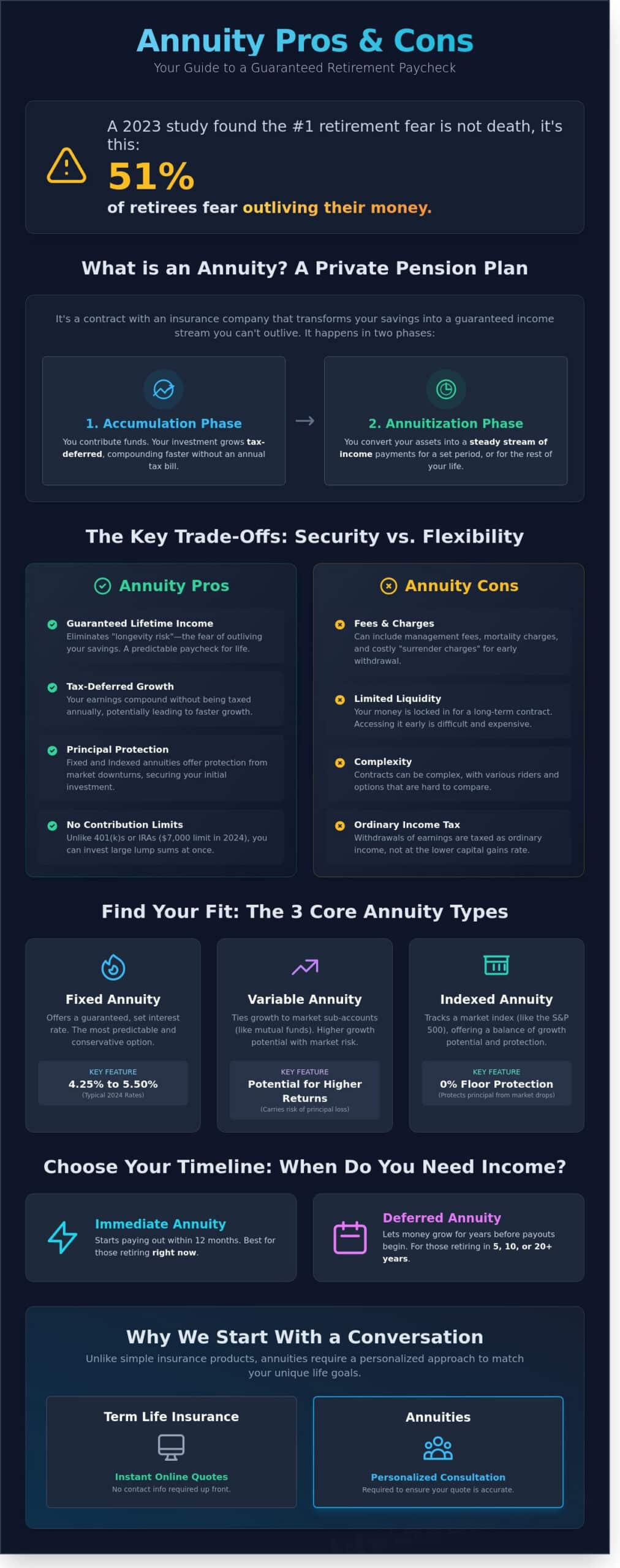
What if the biggest risk to your retirement isn’t a stock market crash, but the simple act of living too long? A 2023 study by the Alliance for Lifetime Income found that 51% of retirees fear outliving their money more than they fear death. We know that market volatility and complex financial jargon can make planning for 2026 feel overwhelming. You want a steady paycheck without the stress of watching ticker tapes every morning. This guide explores the essential annuity pros and cons to help you decide if a guaranteed income stream belongs in your long-term strategy.
We’ll clarify the trade-offs between liquidity and security while comparing annuities to other insurance products. You’ll gain a clear understanding of how these contracts protect your principal and where they might limit your flexibility. While we provide instant term life quotes without requiring your phone number or email, annuities require a different approach. We require your contact information up front for these products because we need to have a detailed discussion with every visitor before providing a quote. This ensures the recommendation fits your unique life goals. You’ll finish this article with a clear roadmap to secure your financial future with confidence.
Key Takeaways
- Learn how to navigate the accumulation and distribution phases to transform your savings into a guaranteed retirement paycheck you cannot outlive.
- Evaluate the essential annuity pros and cons to understand how tax-deferred growth compares to potential surrender charges and management fees.
- Apply our “Sleep Well at Night” test to determine if your current income sources and risk tolerance make an annuity a smart addition to your strategy.
- Discover why we prioritize transparency by connecting visitors with experienced independent agents instead of impersonal call centers for complex planning.
- Understand why we require a personal discussion with prospects up front to ensure the annuity quotes we provide are accurately tailored to your unique financial needs.
Understanding Annuities: More Than Just a Retirement Paycheck
An annuity is a long-term contract we facilitate between you and an insurance company. It’s designed specifically to manage your income during your post-work years. Think of it as a private pension. Since only 15% of private-sector workers had access to traditional pensions in 2023 according to the Bureau of Labor Statistics, annuities fill a vital gap. They help you bridge the distance between Social Security benefits and your total lifestyle costs as you plan for 2026 and beyond.
We believe in making insurance straightforward. You can see term life insurance quotes on our site instantly without entering your name or email. However, for annuities, we require your contact information up front. We need to have a discussion with a prospect before quoting them. This ensures the product we discuss matches your 2026 retirement timeline and specific financial goals.
Your journey with this product involves a two-phase process. First is the accumulation phase. This is when you contribute funds and your investment grows tax-deferred. Next is the annuitization phase. This is when we convert those assets into a regular stream of income. Analyzing the annuity pros and cons helps you decide if this model provides the security you need for your future.
The Core Categories: Fixed, Variable, and Indexed
Fixed annuities offer a set interest rate, often ranging from 4.25% to 5.50% based on 2024 carrier data. They provide a predictable path for conservative visitors. Variable annuities tie your growth to sub-accounts, similar to mutual funds. These offer higher growth potential but carry a risk of losing your principal. Indexed annuities track a market index like the S&P 500. They usually include a 0% floor to protect you from market drops while allowing for moderate gains. Evaluating these annuity pros and cons is essential to finding your comfort zone.
Immediate vs. Deferred Annuities
Immediate annuities start paying out within 12 months of your initial premium payment. They’re an excellent choice if you’re retiring very soon and need a paycheck right away. Deferred annuities are for prospects who are 5, 10, or 20 years away from their retirement date. They let your money compound over time before you start taking withdrawals. Choosing the right one depends on your current age and your distance from your target retirement date. We’re here to help you determine which timeline serves you best.
The Advantages of Annuities: Why Prospects Choose Guaranteed Income
Understanding the annuity pros and cons starts with recognizing their unique ability to provide financial certainty. In 2026, many retirees face the reality of a changing economic environment where traditional pensions are rare. An annuity functions as a private pension, offering a check you can’t outlive. Unlike IRAs or 401(k)s, which have strict annual contribution limits (such as the $7,000 cap for IRAs in 2024), annuities allow prospects to invest large lump sums at once. This makes them a powerful tool for those who’ve recently sold a property or received an inheritance and want to secure their future immediately.
Eliminating Longevity Risk
Longevity risk is the probability that a retiree’s lifespan will exceed their financial resources. This is the top fear for many visitors as medical advancements extend life expectancy toward the age of 90 and beyond. Insurance companies manage this by pooling risk. They collect premiums from a large group, allowing them to provide stable, predictable payouts regardless of how the stock market performs. You don’t have to worry about running out of money at age 85; the insurance company takes on that burden for you.
The Power of Tax Deferral
Tax-deferred growth is a massive advantage for long-term wealth. When your earnings grow without the IRS taking an annual cut, your balance compounds more efficiently. Consider a $100,000 investment over 10 years. In a taxable CD earning 5%, you’d pay taxes on the interest every year, slowing your progress. In an annuity, that 5% grows untouched until you start taking withdrawals. This is especially beneficial for high-income earners who’ve already maxed out other retirement vehicles.
We also provide customizable riders to help you protect against specific life events. These options allow you to build a more robust safety net:
- Long-term care protection: Helps cover home health care or nursing home costs if you can’t perform daily tasks.
- Enhanced death benefits: Guarantees that your heirs receive a specific amount, regardless of market performance.
- Inflation protection: Increases your monthly payouts over time to help maintain your purchasing power.
Because these products are highly individual and complex, we require prospects to provide contact information up front for an annuity or permanent life insurance quote request. We need to have a detailed discussion with you before quoting to ensure we find the right fit for your specific goals. This is different from our term life process, where you can get instant quotes without sharing any personal data. By weighing these annuity pros and cons, you can decide if a guaranteed income stream is the right move for your retirement strategy.
The Drawbacks of Annuities: Fees, Liquidity, and Complexity
While annuities provide a steady income stream, they aren’t right for every portfolio. Understanding the annuity pros and cons means looking closely at the restrictive nature of these contracts. Most annuities are long-term commitments that limit your access to cash when you might need it most. We want our visitors to be fully aware of the trade-offs before they sign a contract that could last decades.
Understanding Surrender Periods
A surrender period is the timeframe where you’ll pay a penalty to withdraw your own money. These typically last between 5 and 10 years. For example, a 7-year surrender schedule might start with a 7% penalty in year one, decreasing by 1% annually. We always advise prospects to maintain a separate emergency fund of at least 6 to 12 months of living expenses before committing to an annuity principal. While most contracts include a “10% rule” allowing you to withdraw a small portion penalty-free each year, taking more can be expensive. If you need a large sum for a medical emergency, those surrender charges can wipe out years of interest or growth.
The Impact of Fees on Performance
Fees can significantly reduce your net returns over a 20-year retirement. Variable annuities often carry Mortality and Expense (M&E) risk charges averaging 1.25% per year. When you add administrative fees and optional income riders, total annual costs can exceed 2% or 3%. In contrast, a low-cost S&P 500 index fund might cost as little as 0.03% annually. We believe in transparency during the quoting process to help visitors avoid “fee shock” later.
Our process for providing quotes reflects the complexity of these products. While you can get instant term life insurance quotes on our site without entering your name or phone number, we require contact information up front for annuities and permanent life insurance policies. We need to have a discussion with a prospect before quoting them because these products aren’t “one size fits all.” A direct conversation ensures we account for all potential fees and rider costs accurately.
Complexity and Inflation Risk
Annuity contracts can span 100 pages of legal jargon. This complexity makes it easy to buy a product you don’t fully understand, especially regarding how death benefits or participation rates work. Inflation risk is another major hurdle. A fixed monthly payment of $3,000 might cover your bills today, but with a 3% average inflation rate, that same $3,000 will only have about $1,660 in purchasing power 20 years from now. Without an inflation-adjusted rider, which typically reduces your initial payout, your standard of living could drop significantly during your later retirement years.
Evaluating Your Options: Is an Annuity Right for You?
Deciding if an annuity fits your 2026 retirement strategy requires a look at your personal comfort levels. We often suggest the “Sleep Well at Night” test. If a 10% or 20% market dip, similar to the 19% S&P 500 drop in 2022, keeps you awake, the guaranteed nature of an annuity might outweigh the potential for higher stock market returns. When weighing annuity pros and cons, consider your existing “floor” of income. If your Social Security, which averages about $1,900 monthly in 2024, and any employer pension already cover 80% of your fixed expenses, you might not need the extra guarantee an annuity provides.
Those extra expenses often relate to lifestyle and hobbies, which become more central in retirement. Whether it’s travel, home improvement, or even setting up a comfortable entertainment space, planning for these costs is key. For example, if you’re researching equipment for a new hobby, it’s wise to explore Affiliate Product Recommendations to find quality reviews and buying guides.
The “best” annuity is never a one-size-fits-all product. It’s entirely dependent on your health status and specific financial goals. If you’re in excellent health and expect to live well into your 90s, a lifetime income rider provides incredible value. If you have significant health concerns, tying up liquidity in a long-term contract might not be the smartest move. We help visitors look at the whole picture to ensure the math actually works in their favor.
Annuities vs. Life Insurance
Annuities and life insurance serve opposite purposes. An annuity protects you from the risk of living too long and running out of money; life insurance protects your family if you die too soon. For many prospects, term life insurance is the most cost-effective way to handle a death benefit need. You can get these quotes on our site instantly without sharing your name, phone number, or email. However, if you’re still in your peak earning years, you might need disability insurance first to protect your ability to save. Because disability and permanent life products are complex, we require your contact information up front. We need to have a discussion with a prospect before quoting them to ensure the coverage is tailored correctly.
A 4-Question Checklist for Prospects
Before moving forward, we ask visitors to run through these four criteria:
- Liquidity: Do you have 6 to 12 months of liquid cash in a standard savings account outside of this investment? For information on financial tools that can help with liquidity for unexpected emergencies, you can check out ILoveUrLoans.
- Tax Strategy: Are you in a high tax bracket, such as 24% or 32%, where tax-deferred growth provides significant value?
- Primary Goal: Is your priority wealth preservation or are you seeking aggressive 10% annual growth?
- Comparison: Have you consulted an independent agent to compare multiple carriers?
We believe in transparency. If an annuity doesn’t solve a specific problem in your retirement plan, we’ll tell you. Our goal is to make the process feel manageable and stress-free. Ready to see how much protection costs? Get an anonymous term life quote in seconds.
How We Help You Navigate the Annuity Quoting Process
Choosing the right financial vehicle for retirement requires more than just looking at a spreadsheet. At LifeInsure.com, we provide a human-centric approach that sets us apart from generic internet quote engines. We don’t use impersonal call centers. Instead, we pair you with an experienced independent agent who guides you through every step. This professional remains your single point of contact, ensuring you never have to repeat your story to five different people. We believe this continuity is essential for helping visitors make an educated decision about their financial future.
Our commitment to transparency means we focus on education first. We want you to fully grasp the annuity pros and cons as they apply to your specific situation. We provide deep analysis into how different carriers handle inflation protection and death benefits. Because we work with multiple top-rated companies, we have the flexibility to match you with a carrier that fits your needs rather than forcing you into a specific product. This objective perspective is vital for anyone planning a 2026 retirement transition.
Why Contact Info is Required Upfront for Annuities
We handle different insurance products with specific protocols to protect your time and privacy. Visitors can access our instant term life engine to see rates without sharing a name, phone number, or email. However, annuities are complex financial contracts that are not one-size-fits-all. For these products, we require your contact information up front.
We must have a discussion with a prospect before quoting them to ensure accuracy. Your tax status, current age, and specific risk tolerance change the math significantly. For instance, a 63-year-old planning to stop working in 2026 has different liquidity needs than a 55-year-old. By speaking with you first, we can provide quotes that are sustainable and realistic for your retirement plan. We don’t want to give you a “ballpark” figure that changes later; we want to give you a solid number you can rely on.
Your Next Steps with LifeInsure.com
Starting your review is a straightforward process designed to reduce stress. To prepare for your consultation, we suggest having your current retirement account balances and a target monthly income goal ready. This data allows us to run precise calculations during our talk.
- No-Pressure Review: You can expect a professional conversation focused on your goals, not a sales pitch.
- Carrier Comparison: We compare options from several 2026-ready carriers to find the best value.
- Personalized Strategy: We help you weigh the annuity pros and cons based on your actual tax bracket and lifestyle needs.
Ready to secure your future? Contact us today to start your personalized annuity review. We are here to simplify the complex and help you move toward retirement with total confidence.
Take Control of Your 2026 Retirement Strategy
Choosing the right path for your future requires a clear look at annuity pros and cons to balance guaranteed income against fees and liquidity. While we provide term life insurance quotes without asking for your personal details, annuities and other products like whole life or disability insurance require a different approach. We require your contact information up front for these quotes. It’s essential that we have a detailed discussion with every prospect before providing a figure to ensure the strategy meets your specific 2026 financial goals.
You’ll work directly with one of our experienced independent agents, not a representative in a call center. We compare top-rated carriers across all 50 U.S. states to find your best fit. Our team maintains a strict privacy-first approach, meaning we never sell your data to third parties. We’re here to make the process straightforward and transparent from your first click to your final decision.
Request a Personalized Annuity Quote Discussion
We’re ready to help you navigate these choices with confidence and clarity.
Frequently Asked Questions
Can I lose my principal investment in an annuity?
You won’t lose your principal in fixed or fixed-indexed annuities because these contracts guarantee your initial deposit. Even if the stock market drops 20% in a single year, your principal remains secure. However, variable annuities carry market risk. If the underlying sub-accounts perform poorly, your account value could decrease. Understanding these annuity pros and cons helps you choose between absolute safety and potential market growth.
Is an annuity better than a 401(k) for retirement income?
Neither is strictly better, as they serve different purposes in a portfolio. A 401(k) is an excellent accumulation tool with a $23,000 contribution limit for 2024. An annuity excels at creating a guaranteed paycheck that you can’t outlive. We often suggest using both to balance growth and security. For a personalized annuity quote, we require your contact information up front so we can have a discussion before quoting.
What happens to the remaining money in my annuity if I die early?
Your beneficiaries will receive the remaining value if you select a death benefit rider or a “period certain” payout. Statistics show that 90% of our prospects choose these protections to ensure their legacy isn’t lost. Without these specific riders, the insurance company might keep the balance upon your death. We’ll help you compare these annuity pros and cons to ensure your family stays protected after you’re gone.
How are annuity payments taxed by the IRS?
The IRS taxes your payments based on whether the funds are qualified or non-qualified. If you use money from a traditional IRA, 100% of your distributions are taxed as ordinary income. For non-qualified funds, the IRS uses an exclusion ratio to determine the tax-free portion of each check. This ensures you’re only taxed on the earnings, not your original investment. We’ll provide clear breakdowns of these tax implications during our consultation.
Can I cancel an annuity contract after I’ve purchased it?
You can cancel your contract during the mandatory free look period. This window typically lasts between 10 and 30 days depending on your state’s specific insurance regulations. If you cancel during this time, you’ll receive a full refund of your premium. After this period, you’ll likely face surrender charges. These fees often start at 7% or 10% of your account value and decrease gradually over several years.
Is there a maximum age to buy an annuity in 2026?
Most insurance carriers set a maximum age limit of 85 for new contracts in 2026. While some specialized products exist for seniors up to age 90, the options become significantly more limited. We recommend exploring these income tools early to lock in the best possible rates. Unlike our term life quotes which are instant and anonymous, we’ll need to speak with you directly to quote these products for seniors.
How do annuity fees compare to mutual fund fees?
Annuity fees are generally higher because they include insurance guarantees that mutual funds don’t provide. While a standard mutual fund might cost 0.50% annually, a variable annuity with a living benefit rider can cost 2.5% to 3% per year. These fees cover the cost of lifetime income promises and death benefit protections. We believe in total transparency and will explain every fee clearly when we have our initial discussion.
Last Updated on August 7, 2026 by Richard Reich
