

Planning for retirement can feel overwhelming. The biggest fear for many is outliving their savings, especially when financial products seem confusing. If you’re looking for a way to create a reliable income stream that market crashes can’t touch, you’ve probably heard the term ‘annuity.’ But trying to understand an annuity can feel like learning a new language, leaving you unsure whom to trust or where to turn for clear answers.
Don’t worry. This guide was created to give you straightforward, honest information. We’ll break down exactly how annuities work, explore the different types, and lay out the real pros and cons in simple terms. Our goal is to demystify this financial tool, giving you the confidence to understand its potential role in your retirement plan and decide if it’s the right choice for your financial security. You’ll walk away feeling empowered to make an educated decision for your future.
Key Takeaways
-
This guide explains what an annuity is: a personal pension plan you create to guarantee income in retirement.
-
Learn to distinguish among the three main types of annuities to find an option that aligns with your risk and growth goals.
-
Weigh the key benefits and potential drawbacks to confidently decide if an annuity is the right tool for your financial future.
-
Understand the critical difference between an annuity (protecting you) and life insurance (protecting your family) to build a complete financial plan.
Table of Contents
What Is an Annuity in the Simplest Terms?
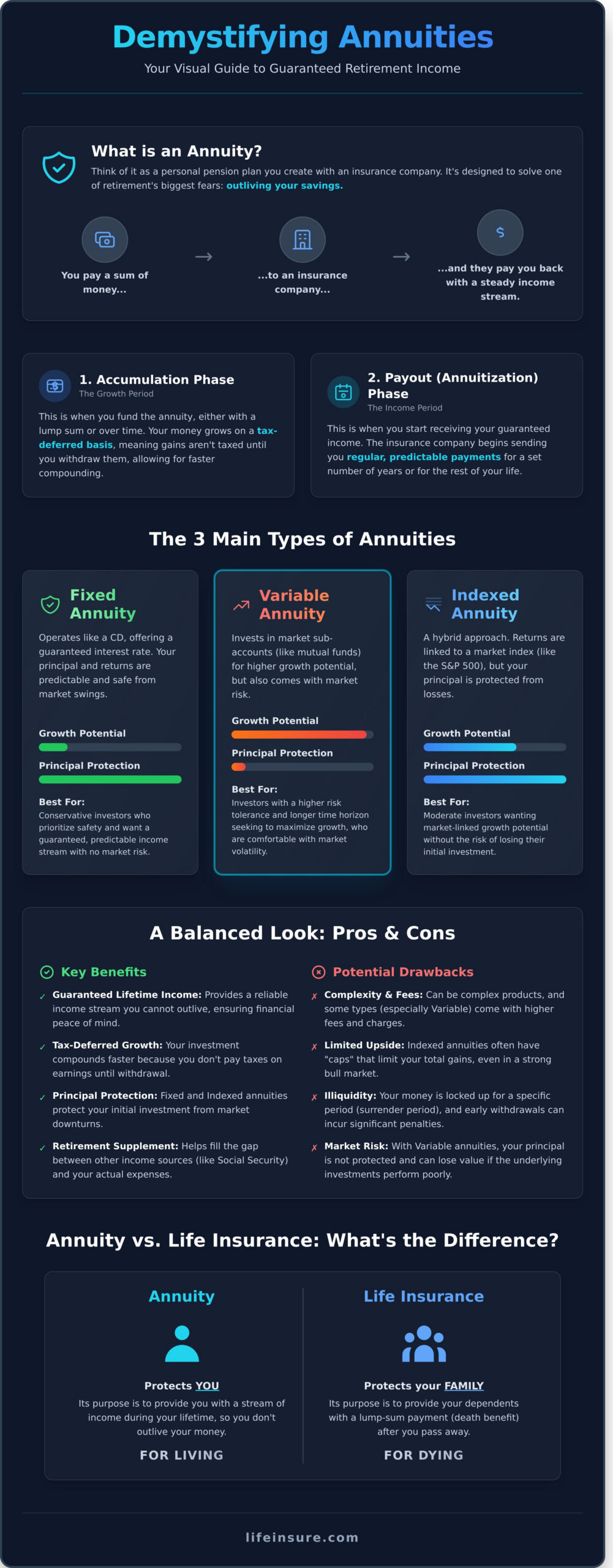
Think of an annuity as a personal pension plan you create for yourself with an insurance company. It’s a straightforward agreement: you pay an insurer a sum of money (either all at once or over time), and in return, they promise to pay you back with a steady stream of income in the future. At its core, an Annuity is a financial product designed to provide a reliable income source, particularly during retirement.
The primary goal of an annuity is to solve one of the biggest financial fears people face: outliving their savings. By converting a portion of your assets into a guaranteed income stream, you can ensure you have money coming in for a set period or even for the rest of your life. Understanding what an annuity is is the first step toward building a more secure financial future.
The Two Main Phases: Accumulation and Payout
An annuity operates in two distinct stages. The first phase is the accumulation phase, during which you fund the contract. You might make a single lump-sum payment or contribute smaller amounts over several years. During this time, your money has the potential to grow on a tax-deferred basis, meaning you won’t pay taxes on the earnings until you start receiving payments.
The second stage is the payout (or annuitization) phase. This is when the insurance company begins making regular payments to you. You can typically choose how you receive this income, for example, for a specific number of years or as a lifelong guarantee.
Why Do People Buy Annuities?
While every situation is unique, people are generally drawn to annuities for a few key reasons. They are powerful tools for retirement planning because they help you:
-
Create a guaranteed income stream you cannot outlive, providing peace of mind in your later years.
-
Supplement other retirement income sources, such as Social Security or a 401(k), which may not be enough on their own.
-
Benefit from tax-deferred growth, allowing your investment to compound more quickly without an annual tax bill on the gains.
-
Protect a portion of your portfolio from market downturns, as many annuities offer protection against investment losses.
The 3 Main Types of Annuities Explained
Once you understand the basic answer to "what is an annuity?", the next step is to see how they can be tailored to different financial goals. The main difference between annuities comes down to one key factor: how your money earns interest or returns. Think of it as a spectrum balancing risk and growth potential. To keep things simple, the Financial Industry Regulatory Authority (FINRA) outlines three core types of annuities that every investor should know.
Let’s break down each one in straightforward terms so you can feel confident in understanding your options.
Fixed Annuities: The Power of Predictability
A fixed annuity is the most straightforward option, operating much like a certificate of deposit (CD). You receive a guaranteed, fixed interest rate on your investment for a specific period. The key benefit is its security: your principal is protected, and your returns are predictable and completely insulated from stock market fluctuations. This makes financial planning simple and stress-free.
- Best for: Conservative investors or retirees who prioritize protecting their principal and want a reliable, guaranteed stream of income without any market risk.
Variable Annuities: The Potential for Market Growth
With a variable annuity, you have the opportunity to generate higher returns by investing your money in a portfolio of sub-accounts. These sub-accounts are similar to mutual funds and are invested in stocks and bonds. The trade-off for this higher growth potential is market risk. If your chosen investments perform well, your account value grows; if they perform poorly, it could decrease.
- Best for: Investors with a longer time horizon and a higher tolerance for risk who seek to maximize growth and are comfortable with market ups and downs.
Indexed Annuities: A Hybrid Approach
An indexed annuity, sometimes called a fixed-indexed annuity, offers a blend of the features above. Its returns are linked to the performance of a market index, such as the S&P 500, giving you the potential for growth when the market rises. However, it also includes a crucial layer of protection: you typically cannot lose your principal, even if the market goes down. The trade-off is that your upside is often limited by a "cap" or "participation rate," meaning you only get a portion of the index’s total gains.
- Best for: Moderate investors seeking market-linked growth but unwilling to risk losing their initial investment.
Immediate vs. Deferred Annuities: When Do Payouts Begin?
When you’re exploring what is an annuity, one of the first and most important questions to answer is simple: Do you need income now, or are you saving for later? Your answer to this question determines the entire structure of your contract. This choice splits annuities into two main categories: immediate and deferred. It’s important to note that both types can be structured as fixed, variable, or indexed annuities, but their core purpose is determined by when you receive payments.
Immediate Annuities: Creating Income Today
An immediate annuity is designed for one primary goal: to convert a lump-sum payment into a guaranteed stream of income almost immediately. You fund the contract with a single premium payment, and in return, the insurance company begins sending you regular checks, typically within one year.
-
Purpose: Best for individuals at or near retirement who need to turn their savings (like a 401(k) rollover or inheritance) into a reliable ‘paycheck’ to cover living expenses.
-
Real-World Example: A 65-year-old retiree uses $250,000 from her savings to purchase an immediate annuity. Starting next month, she will receive a check for $1,500 every month for the rest of her life, providing a predictable income she can’t outlive.
Deferred Annuities: Building Savings for Tomorrow
A deferred annuity, on the other hand, is a long-term savings vehicle. You can fund it with a single lump sum or a series of payments. The money is left to grow tax-deferred during what’s called the "accumulation phase." Payouts don’t begin until a future date you choose, often years or even decades later. The official IRS definition of an annuity outlines how this tax-deferred growth works, making it a powerful tool for retirement planning.
-
Purpose: Ideal for people still in their working years who want to supplement their retirement savings and take advantage of tax-deferred growth.
-
Real-World Example: A 50-year-old professional contributes $10,000 a year into a deferred annuity. The funds grow for 15 years without being taxed on the gains. At age 65, he can choose to "annuitize" the contract and start receiving a steady stream of income to support his retirement lifestyle.
Pros and Cons of Annuities: A Balanced Look
Annuities can be a powerful financial tool for securing your retirement, but they aren’t the right fit for everyone. Like any major financial decision, it’s essential to weigh the benefits against the potential drawbacks. We believe in making educated decisions, so here’s a straightforward, balanced look to help you understand if an annuity aligns with your goals.
The Key Advantages of Annuities
When used correctly, annuities offer several distinct benefits for long-term financial planning. They are designed to provide security and predictability when you need it most.
-
Guaranteed Income for Life: This is the core promise of many annuities. They can provide a predictable stream of payments you cannot outlive, offering peace of mind and protection against outliving your savings.
-
Tax-Deferred Growth: Your money grows without being taxed annually. This allows your earnings to compound more quickly over time, maximizing your investment potential until you begin taking withdrawals.
-
Principal Protection: Unlike direct market investments, fixed and fixed-indexed annuities offer safeguards that protect your principal from market downturns, ensuring your initial investment is secure.
-
Death Benefits: Most annuities include a provision that allows you to pass on any remaining value to your beneficiaries, often bypassing the lengthy and public probate process.
The Disadvantages and Risks to Consider
While the benefits are clear, the drawbacks highlight why understanding what an annuity is in full detail is so important. We’re committed to transparency, so be sure to consider these factors:
-
Fees and Expenses: Annuities may incur various charges, including administrative fees, mortality and expense (M&E) risk charges, and optional rider fees. It’s crucial to know what these costs are upfront, as they can reduce your overall returns.
-
Complexity: The contracts can be lengthy and contain technical language. It’s often difficult to fully grasp the terms without professional guidance from an experienced agent.
-
Illiquidity: Your money is meant for the long term. Withdrawing funds before a specified period (the "surrender period") can trigger significant surrender charges, which can be costly.
-
Tax Treatment of Gains: When you withdraw earnings, they are taxed as ordinary income, which may be taxed at a higher rate than the long-term capital gains rates applied to other investments, such as stocks.
Navigating these factors requires a clear picture of your personal financial situation. If you’re unsure how these pros and cons apply to you, our experienced independent agents can provide clear, honest guidance to help you make a confident decision.
Annuities vs. Life Insurance: What’s the Difference?
Understanding the roles of various financial tools is essential to building a comprehensive and secure financial plan. While both annuities and life insurance provide long-term security, they are designed to address opposite needs. Getting this distinction right is a crucial step in protecting both yourself and your loved ones.
A truly complete plan also accounts for other major financial risks, such as healthcare costs, which can be particularly complex when living internationally. For those residing in or moving to Europe, specialized health coverage from a provider like Insurance VISA is an essential part of their financial safety net.
The simplest way to think about it is this: Annuities protect you from outliving your money, while life insurance protects your family if you pass away unexpectedly. Let’s break down their core functions.
Primary Goal: Income for You vs. Money for Your Heirs
At their core, these two products serve fundamentally different purposes. Understanding what an annuity is begins with its goal: to provide you with a guaranteed stream of income, typically during retirement. It acts as your personal pension plan, ensuring you have money to live on for as long as you live.
Life insurance, on the other hand, is designed for your beneficiaries. Its primary goal is to provide a tax-free, lump-sum payment to your loved ones upon your death. This financial safety net helps them cover expenses like a mortgage, college tuition, and daily living costs in your absence.
-
Annuity Analogy: A solution for the financial risk of living too long and running out of savings.
-
Life Insurance Analogy: A solution for the financial risk of dying too soon and leaving dependents unprotected.
How They Can Work Together
A comprehensive financial strategy often uses both products in harmony. An annuity can be set up to provide a steady, reliable income throughout your retirement, covering your expenses and lifestyle needs. This ensures your personal financial security is handled.
Simultaneously, a life insurance policy provides peace of mind, knowing that your spouse, children, or business partners will receive the funds they need to carry on without you. While some annuities offer a death benefit, it is typically a return of your premium and not comparable to the significant, dedicated payout from a life insurance policy.
While an annuity secures your income, life insurance secures your legacy. Compare life insurance quotes instantly to protect your loved ones.
Your Path to a Secure Financial Future
Ultimately, understanding what an annuity is is about empowering yourself with the knowledge to build a stronger retirement plan. As we’ve covered, annuities can provide a reliable income stream, but they are just one piece of the puzzle. While an annuity is designed to provide for you during your lifetime, a comprehensive plan also includes protection for your loved ones after you’re gone. This is where life insurance plays its vital role.
Ready to protect your family’s financial future? You can compare instant term life insurance quotes right now, completely hassle-free. We believe in making the process easy and transparent. You’ll get instant quotes without providing your name or phone number, and you can compare policies from top-rated insurance companies side by side. Best of all, you’ll work with an experienced independent agent, not a call center, to find the right fit. Taking control of your financial security is an empowering step, and we’re here to help.
Frequently Asked Questions About Annuities
Are annuities a good investment for retirement?
Annuities can be a very good tool for retirement, but they are designed for income security, not aggressive growth. To decide if one is right for you, it helps to understand what is an annuity: a contract that provides a guaranteed stream of income. This makes them an excellent choice for retirees seeking predictable, lifelong payments to cover essential expenses. However, they may not be ideal for those seeking high returns or who need flexible access to their funds.
Can you lose your money in an annuity?
It depends on the type. With a fixed annuity, your principal is protected and backed by the financial strength of the issuing insurance company. The risk of loss is very low. However, with a variable annuity, your funds are invested in sub-accounts similar to mutual funds. If these underlying investments perform poorly, the value of your account can decrease, and you can lose money. Always review the specific guarantees and risks of any annuity before purchasing.
At what age should you consider buying an annuity?
There is no perfect age, but most people purchase annuities as they approach or enter retirement, typically in their 50s and 60s. This is the time to shift focus from accumulating wealth to creating a reliable income stream from your savings. Buying an annuity too early can lock up your money for a long period and subject you to significant surrender charges if you need to withdraw funds before the contract term ends.
How are annuity payouts taxed?
Taxation depends on whether the annuity is "qualified" or "non-qualified." Payouts from a qualified annuity, funded with pre-tax money like a 401(k) rollover, are fully taxed as ordinary income. For non-qualified annuities, funded with after-tax money, you only pay income tax on the earnings portion of the payout. Your original principal is returned to you tax-free. This is known as the exclusion ratio, which separates the taxable gains from the non-taxable return of premium.
What happens to an annuity when you die?
The outcome depends on the contract’s terms and payout options. If you die during the accumulation phase, your named beneficiary typically receives the account value or a guaranteed minimum amount. If you die after payments have begun, a "life-only" option ceases payments. However, options like "joint and survivor" continue payments to a spouse, while a "period certain" option guarantees payments to a beneficiary for a specified number of years, ensuring your investment isn’t lost.
How much do annuities typically cost?
Annuity costs are built into the contract rather than paid as an upfront fee. These can include mortality and expense (M&E) charges, often around 1.25% annually for variable annuities, and administrative fees. You may also pay for optional riders that provide enhanced benefits, like a guaranteed lifetime income. Be aware of surrender charges, which are fees for withdrawing money early, often starting around 7% in the first year and declining over several years.
Last Updated on April 16, 2026 by Richard Reich