

By 2026, an estimated 4.1 million Americans will turn 65, marking the peak of the "Silver Tsunami." Yet, a 2023 study by the Alliance for Lifetime Income found that 51% of those aged 45 to 75 worry they’ll outlive their savings. You likely share this concern as market volatility turns retirement planning into a source of stress rather than excitement. We know that complex jargon and the fear of hidden commissions make choosing an annuity feel like a gamble. We’re here to provide a transparent, professional roadmap so you can determine if a guaranteed income stream fits your specific goals.
We agree that your retirement should be defined by security, not confusion. We promise to demystify the mechanics of these financial tools and show you how they compare to traditional life insurance. While we offer instant term life quotes without requiring personal info, we handle annuities differently. We require contact information up front for these quotes because we need to have a detailed discussion with prospects to ensure the plan matches their unique needs. You’ll work with an experienced agent who guides you through every step. Let’s explore how to build a reliable financial foundation for 2026 and beyond.
Key Takeaways
-
Learn how a long-term annuity contract transforms your savings into a reliable, guaranteed stream of income that you cannot outlive.
-
Compare the risk-versus-reward profiles of fixed, variable, and indexed options to find the perfect fit for your financial comfort zone.
-
Evaluate how these income solutions complement your existing 401(k) or IRA to build a more resilient and predictable retirement foundation.
-
Understand that while we offer term life quotes without personal info, we require contact details up front for these products so we can have a discussion with a prospect before quoting them.
-
Discover how to assess the financial strength of insurance providers to ensure the long-term security and stability of your future payments.
Table of Contents
What is an Annuity? Understanding the Foundation of Lifetime Income
At LifeInsure.com, we believe that financial security should be straightforward and stress-free. We define an What is an Annuity? as a long-term contract between a visitor and an insurance company designed to provide a steady stream of income. You provide a lump sum or a series of payments over time; in exchange, we provide a guaranteed income that can last for a specific period or your entire life. It is essentially a legal agreement in which the insurance company assumes the risk of your longevity.
You can think of this as the mirror image of life insurance. While life insurance is designed to protect your family against the financial risks of "dying too soon," an annuity protects you against the risk of "living too long." In 2026, this distinction is more vital than ever. Data from the Bureau of Labor Statistics shows that 85% of private-sector workers no longer have access to traditional defined-benefit pensions. This shift has turned these contracts into a vital "private pension" for prospects who want to ensure they don’t outlive their savings.
We want to be transparent about how we work to help you make an educated decision. If you are searching for term life insurance, you can get instant quotes on our site without entering your name, phone number, or email. However, for an annuity, we require contact information up front. This is because these products are highly personalized. We need to have a detailed discussion with a prospect before quoting them to ensure the contract structure matches their specific retirement timeline and income needs.
The Two Primary Phases of an Annuity
The first stage is the Accumulation Phase. During this time, your money grows through interest or various investment options. Under 2026 tax rules, your earnings grow on a tax-deferred basis, meaning you don’t pay taxes on the growth until you start taking withdrawals. This allows your balance to compound more efficiently over many years. The second stage is the Distribution Phase, which is when you begin receiving your steady stream of payments to fund your lifestyle. Annuitization is the formal process of transitioning your account from the growth stage into a permanent stream of guaranteed income payments.
Why Prospects Choose Annuities in 2026
-
Longevity protection: You receive a guarantee that you cannot outlive your financial resources, regardless of how long you live.
-
Tax-deferred growth: Your earnings accumulate without immediate taxation, which can lead to a larger nest egg compared to taxable accounts.
-
Customizable riders: You can add specific features, such as inflation protection to keep up with rising costs or death benefits to ensure your beneficiaries receive any remaining balance.
Our experienced independent agents are here to guide you through this process. We don’t use a call center model; instead, you’ll work with a dedicated professional who stays with you from start to finish. We focus on clarity and simplicity to help you feel empowered and secure about your financial future.
How Annuities Work: Mechanics, Payouts, and Provisions
We view an annuity as a legal agreement designed to provide financial security. You provide a premium, either as a single lump sum or through a series of payments. In exchange, the insurance carrier credits your account with interest and promises a future income stream. Unlike our term life insurance quotes, which you can access without sharing your name or email, we require your contact information up front for these products. We need to have a discussion with a prospect before quoting them because the variables involved are highly personal. We want to ensure the carrier we recommend has the financial strength to back their promises. We look for companies with "A" ratings or better from agencies like A.M. Best to ensure your checks arrive on time for decades.
Most contracts include a surrender period. This is a timeframe, often lasting 5 to 10 years, where withdrawing more than a set percentage of your money results in a penalty. These charges might start at 7% or 8% and decrease annually until they hit zero. We also watch the broader economy closely. By 2026, many economists predict interest rates will stabilize around 3.5%. These rates are vital because they dictate the payout rate carriers offer. When rates are higher, the insurance company can generate more internal profit, which it passes on to you as a larger monthly check.
Immediate vs. Deferred Options
An immediate annuity, often called a SPIA, starts paying you within 12 months. It’s a popular choice for visitors who are already 65 or older and need cash flow now. A deferred contract is different. It allows your principal to grow tax-deferred for years before you trigger the income phase. This structure is often better for long-term retirement goals because it maximizes the power of compounding. We help you decide which path is right based on your specific retirement countdown.
Payout Options: Customizing Your Income Stream
-
Life Only: This provides the highest possible monthly payment. The trade-off is that payments stop immediately upon your passing, leaving no balance for heirs.
-
Life with Period Certain: You receive income for life, but the carrier also guarantees payments for a specific window, such as 10 or 20 years. If you die in year five, your beneficiary receives the remaining checks for the rest of that term.
-
Joint and Survivor: This is a common choice for couples. It ensures that if one spouse passes away, the surviving spouse continues to receive a check, often for the same amount or a slightly reduced percentage, such as 75%.
Choosing the right payout structure is just as vital as picking the right carrier. If you’re curious about how these numbers look for your specific situation, you can speak with an experienced agent to explore your options. We’ll walk you through the math so you can make an educated decision without any high-pressure sales tactics.
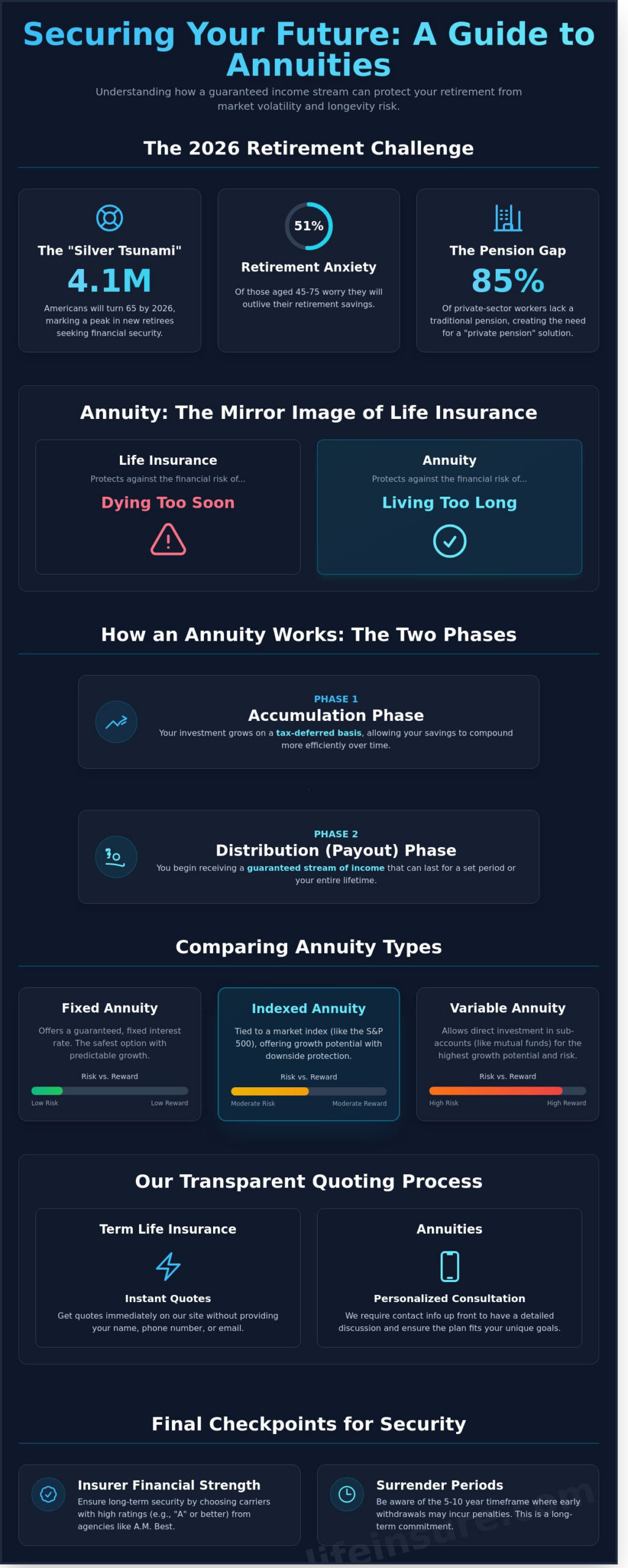
Comparing Annuity Types: Fixed, Variable, and Indexed
Choosing the right annuity involves weighing your need for a steady paycheck against your desire for higher returns. We analyze three primary categories to help you find the balance that fits your specific retirement goals. Each choice impacts your future lifestyle differently. Some visitors prioritize absolute safety, while others want to capture market gains to outpace inflation. Understanding how these products behave in different market cycles is the first step toward a secure financial future.
Fixed Annuities: Stability in a Volatile World
Fixed annuities function as the bedrock of a conservative retirement plan. They provide a guaranteed interest rate for a specific period, functioning much like a Certificate of Deposit but with the added benefit of tax-deferred growth. Multi-Year Guaranteed Annuities (MYGAs) are a primary tool for this strategy. In the 2026 rate environment, many five-year MYGAs offer guaranteed annual returns ranging from 5.15% to 5.45%. This predictability appeals to prospects who want to protect their principal above all else. Fixed annuities are not subject to market downturns. Because the insurance company assumes the investment risk, your account balance remains stable even if the stock market enters a correction.
Variable and Indexed Options: Seeking Growth
If you have a longer time horizon, you might consider products that offer more upside. Variable products give you direct exposure to market sub-accounts. This means your money is actually invested in portfolios of stocks or bonds. While the growth potential is significantly higher than fixed options, these products carry a real risk of loss if the market declines. You must also account for the various costs involved. Variable products often include Mortality and Expense (M&E) charges averaging 1.25% annually. When you add investment management fees, total annual costs can sometimes exceed 2.75%.
Indexed options offer a middle ground for those who want growth without risking principal. These credit products pay interest based on the performance of a market index, such as the S&P 500, but include a floor, usually 0%, to prevent losses in bad years. To provide this safety, insurers use caps and participation rates. For example, if your contract has an 8% cap and the index rises 15%, your gain is limited to 8%. Alternatively, a 75% participation rate means you only receive 75% of the index’s total gain. You can find more details on these trade-offs in this SEC guide to annuities. These mechanisms allow you to participate in market rallies while ensuring your balance never drops as a result of index performance.
The Importance of a Personalized Discussion
We believe in being transparent about how you receive quotes from us. If you are looking for term life insurance, you can get instant quotes on our site without sharing your name or phone number. However, an annuity is a more complex financial instrument. For products like annuities, whole life, or disability insurance, we require your contact information up front. We do this because we must have a detailed discussion with a prospect before providing a quote. Every person has a unique risk tolerance and specific income requirements. We need to analyze your financial picture to determine which participation rates or fee structures actually benefit you. This personalized approach ensures you don’t end up with a product that fails to meet your long-term needs. Our experienced independent agents stay with you through the entire process to help you make an educated decision.
Is an Annuity Right for You? Strategic Considerations
Deciding to purchase an annuity isn’t a snap judgment. It’s a strategic move to ensure you don’t outlive your savings. We help visitors determine if this product fits alongside Social Security and 401(k) distributions. Our quoting process for this product is unique. Unlike our term life insurance tool, where you get instant quotes without sharing your name, annuities require a personal conversation. We need to have a discussion with a prospect before quoting them because these products are highly customized to your specific age, health status, and income needs. This personalized approach ensures the numbers we provide are accurate and realistic for your situation.
The Role of Annuities in a Balanced Portfolio
Many retirees use an annuity as a "safe bucket" to cover fixed costs like housing or healthcare. A common industry rule suggests annuitizing 25% to 40% of a nest egg to create a floor of guaranteed income. This protects against market volatility. We often recommend cost-of-living adjustment (COLA) riders. Without a 2% or 3% annual increase, inflation can erode your purchasing power over a 20-year retirement. These riders provide a vital hedge against rising prices.
Integrating these products into a broader financial plan is a key step. For example, comprehensive wealth management firms like Timothy Roberts & Associates, LLC help clients coordinate annuities with their investments and tax strategies to ensure all components work together.
Annuities vs. Other Insurance Products
Sometimes a different solution serves you better. For working professionals under age 50, disability insurance is often a higher priority to protect their current earning years. If your primary goal is leaving a legacy rather than personal income, you might choose a permanent life insurance policy for its death benefit. Some prospects prefer hybrid policies. These combine long-term care riders with life insurance, offering a dual safety net that standard annuities might lack. We require contact information up front for these quotes to ensure we match you with the right carrier.
The Liquidity Objection
One common concern involves "locked away" money. Most contracts allow you to withdraw up to 10% of your account value annually without incurring company penalties. However, the IRS generally imposes a 10% tax penalty on withdrawals made before age 59.5. You should also remember that annuity gains are taxed as ordinary income. This differs from the lower capital gains rates applied to traditional brokerage accounts. We want you to be fully aware of these trade-offs before committing your capital. It’s about finding the balance between accessibility and security.
-
Ordinary Income Tax: Withdrawals are taxed at your current tax rate, which could be as high as 37% in 2024.
-
Surrender Charges: These fees often start around 7% and decrease over a 5 to 10-year period.
-
Death Benefits: Most modern contracts include a provision to return the remaining principal to your heirs.
We believe in transparency. Our goal is to make the process feel manageable and stress-free. Whether you’re looking for an immediate income stream or a long-term growth vehicle, we act as your experienced guide. We don’t use high-pressure sales tactics; we provide the clarity you need to make an educated decision. If you’re ready to see how these numbers look for your specific retirement timeline, our independent agents are ready to help you compare options from top-rated carriers.
Compare retirement income options and get a personalized quote today
How We Help You Navigate the Annuity Quoting Process
We believe in total transparency throughout your financial journey. If you are looking for instant term life insurance quotes, you can get them on our website right now without sharing your name, email, or phone number. We built that system to respect your privacy and provide immediate data. However, an annuity works differently. For these products, as well as whole life, disability, and long-term care insurance, we require your contact information up front. We need to have a direct discussion with every prospect before we provide a quote.
Annuities are complex financial instruments. They aren’t simple commodities like a 10-year term policy. To give you an accurate and meaningful number, we must understand your full financial picture. An automated quote for a fixed indexed annuity might look attractive on a screen, but it could be entirely wrong for your specific tax bracket or your liquidity needs. We want to avoid the "garbage in, garbage out" problem that often happens with basic online calculators. By speaking with you directly, we ensure the numbers we provide are grounded in reality. You won’t deal with a high-pressure call center. Instead, you’ll work with an independent agent who has a minimum of 15 years of experience in the field.
What to Expect During Our Discussion
We start by looking at your retirement timeline. If you’re 62 and planning to retire at 67, your strategy differs wildly from someone who is 50. We’ll calculate your projected income needs and identify how much of your legacy you want to protect for your heirs. Our agents compare products from 40 different top-rated carriers to find the most competitive rates. We prioritize transparency. This means we clearly explain every 7% or 10% surrender charge and all internal fee structures. We even disclose how commission structures work so you feel confident in your choice.
Starting Your Journey with LifeInsure.com
Submitting your request is simple. Once you fill out the initial form for an annuity or permanent life consultation, a seasoned agent will reach out to schedule a brief call. Because we’re an independent brokerage, we represent you, not the insurance company. We have the freedom to shop the entire market to find the highest participation rates and lowest fees. We’ve helped over 50,000 families secure their futures since we opened our doors. This experience allows us to spot hidden contract details that a computer program would miss. We’re here to be your educator and your advocate.
We don’t believe in "selling" you a product. Our goal is to empower you with the facts so you can make an educated decision for your family. It’s about finding the right fit for your unique situation, not the most convenient option for the insurer. We stay with you from the first conversation through the life of the policy.
Ready to secure your future? Contact our experienced agents today to start the conversation.
Take Control of Your 2026 Retirement Strategy
Securing your financial future requires a clear plan for guaranteed income. We’ve explored how a fixed or indexed annuity protects your savings from market swings while providing a steady paycheck for life. While our website offers instant, anonymous quotes for term life insurance, our process for retirement products is different. We require your contact information up front for these plans because we need to have a detailed discussion with you before providing a quote. This ensures your strategy aligns perfectly with your specific 2026 financial goals.
When you connect with us, you’ll work directly with an experienced independent agent. You won’t be routed to a call center. Our team provides access to quotes from over 50 top-rated insurance carriers to find your best fit. We follow a privacy-first approach; we never sell or share your personal info with outside parties. Richard Reich and our team have provided transparent guidance since 1986 to make coverage more affordable than you realize. It’s time to replace retirement anxiety with a secure, professional strategy that lasts as long as you do.
Request a Personalized Annuity Consultation
Frequently Asked Questions
What is the difference between a fixed and a variable annuity?
A fixed annuity provides a guaranteed interest rate, usually between 3.25% and 5.15% in the current market. A variable annuity fluctuates based on the performance of the sub-accounts you choose. You get a predictable income stream with fixed options, while variable options offer higher growth potential with more risk. We require a brief discussion with prospects to provide these quotes. Unlike our instant term life quotes, we need your contact info up front for annuities.
Can I lose money in an annuity if the stock market crashes?
You won’t lose your principal investment in a fixed or fixed-indexed annuity during a market crash. These products often feature a 0% floor, ensuring your balance stays level even if the S&P 500 drops by 20% or more in a single year. Variable products don’t offer this same protection. We help visitors understand these safeguards during our initial consultation. Because we need to tailor these solutions, we collect your details up front before quoting.
How are annuity payments taxed by the IRS in 2026?
The IRS taxes the interest portion of your payments as ordinary income at your 2026 marginal tax rate. If you bought the contract with pre-tax dollars from a 401(k) rollover, the entire payment is usually taxable. For after-tax purchases, the exclusion ratio determines the tax-free portion. We’ve seen middle-income tax rates recently sit at 22% or 24%. Our experienced agents discuss these specific tax implications with you directly before you commit.
Is it better to invest in a 401(k) or an annuity for retirement?
Choosing between a 401(k) and an annuity depends on whether you prioritize growth or guaranteed lifetime income. Most 401(k) plans offer a company match, which is a 100% match on your contributions. These contracts provide a pension-style check that you can’t outlive. Many retirees use a 401(k) to build wealth and then convert a portion of it into a secure income stream. We need to have a discussion with you to compare these options.
What happens to my annuity if I pass away before the payments end?
Your beneficiaries receive the remaining value of your contract if you select a period-certain or an installment-refund option. Without these riders, payments might stop immediately upon your death. Data shows 88% of modern contracts include some form of death benefit for heirs. We’ll walk you through these choices during our quote process. Since these details change the price, we require your contact information up front to provide an accurate quote for our visitors.
Are annuities worth the fees compared to low-cost index funds?
Insurance fees are often higher than the 0.05% expense ratio of a low-cost index fund because they pay for lifetime income guarantees. You might pay 1.1% for administrative costs and another 1.25% for a living benefit rider. These costs buy you peace of mind that a market downturn won’t deplete your income. We believe in transparency about these costs. We share full fee disclosures during our one-on-one consultations with prospects before they buy.
Can I withdraw money from an annuity in an emergency?
You can typically withdraw 10% of your account value annually without paying a surrender charge. If you take out more, you might face a penalty starting at 7% or 9% in the first year. The IRS also imposes a 10% tax penalty on withdrawals made before age 59.5. We make sure visitors understand these liquidity constraints. To get a quote for a liquid product, we’ll need to speak with you and collect your info.
How do interest rates in 2026 affect my potential annuity payout?
Higher interest rates in 2026 will likely increase the monthly payout you receive from a new contract. For every 1% increase in the 10-year Treasury yield, payout rates for immediate contracts often rise by 0.5% to 0.7%. We track these movements daily to give you the best advice. Unlike our term life engine, where you get quotes without personal info, these quotes require a discussion. We collect your contact details up front.
Last Updated on August 7, 2026 by Richard Reich
