

By Richard Reich | Independent Life Insurance Broker | CA License #0832938 | 30+ years specializing in impaired risk and high-risk life insurance placements, along with Disability Insurance and Annuities.
Trying to find a straightforward cost for whole life insurance can feel impossible. You’ve likely searched for a simple whole life insurance calculator, only to find confusing forms or vague estimates that leave you with more questions than answers. It’s a common frustration: whole life insurance seems overly complex, potentially expensive, and you’re worried about getting locked into a policy you don’t fully understand, especially when concepts like ‘cash value’ are involved. We’re here to bring clarity to that process.
This guide is designed to empower you. We will outline how to estimate your 2026 premiums and explore the key factors that drive your final cost. More importantly, we’ll help you understand why a simple online tool can’t tell the whole story and why a real conversation is so valuable. Our goal is to give you the confidence and knowledge you need to get a realistic ballpark cost and decide if whole life insurance is the right financial step for you, long before you ever speak with an agent.
Key Takeaways
- Learn why most instant online tools can’t accurately price whole life insurance and what to use instead for a reliable estimate.
- Identify the 5 key factors that most affect your premium so you can better understand your final quote.
- See how a portion of your premium isn’t just a cost but a financial asset you build through your policy’s cash value.
- Use our guide and sample rate charts as a more effective whole life insurance calculator to prepare for a conversation with an agent.
Table of Contents
- Why You Can’t Find an Accurate Instant Whole Life Calculator
- How to Manually Estimate Your Whole Life Insurance Premiums
- The 5 Key Factors That Drive Your Whole Life Insurance Cost
- Calculating the ‘Value’ in Cash Value Life Insurance
- Next Steps: From Calculator Estimate to an Official Quote
- Frequently Asked Questions
Why You Can’t Find an Accurate Instant Whole Life Calculator
If you’ve been searching online for a whole life insurance calculator, you may have noticed something frustrating: it’s nearly impossible to get an instant, accurate quote. There’s a straightforward and honest reason for this. Unlike simpler insurance products, whole life is a complex financial tool, and any “instant” quote you find is likely to be a wild guess.
We believe in transparency, and providing you with a faulty tool would be a disservice. Instead, let’s explore why obtaining a real, whole-life quote requires a more personal touch. It’s a whole life insurance policy designed to last your entire life, combining a death benefit with a savings component. Pricing it correctly involves more than just your age and a few health questions.
Term vs. Whole Life: The Simplicity Factor
Getting an instant quote for term life insurance is easy because the product itself is simple. You pay a set premium for a specific amount of coverage over a fixed period (the “term”). Insurers can accurately calculate this risk with basic information. Whole life is different. The premiums are designed to cover you for life and fund a separate, tax-deferred cash value account, making the calculation much more complex.
The Role of Cash Value and Dividends
A key feature of this permanent coverage is its cash value. A portion of every premium you pay helps this account grow. To give you an accurate projection, an insurer needs to create a detailed financial illustration showing how this value might accumulate over decades. This growth can be influenced by interest rates and potential dividends from the insurer, which an online form simply can’t predict or guarantee.
The Need for Detailed Underwriting
Because a whole life policy is a lifelong contract, the underwriting process is far more thorough. Insurers need a complete picture of your health, family history, and financial standing to place you in the correct risk class. Understanding whole life insurance means recognizing that an instant online tool can only estimate these critical factors, leading to quotes that may differ significantly from your final, approved rate.
How to Manually Estimate Your Whole Life Insurance Premiums
While our online tools provide instant quotes, you can get a reliable ballpark figure in just a few minutes with a simple calculation. Think of the steps below as a manual whole-life insurance calculator to help you understand how your premium is determined. It’s important to remember that these are estimates. Your final, official rate is set by the insurance company after a formal underwriting process that assesses your health and lifestyle. For more on the fundamentals, FINRA’s overview of life insurance provides a helpful, neutral perspective from a trusted regulatory authority.
Step 1: Find Your Rate in Our Sample Chart
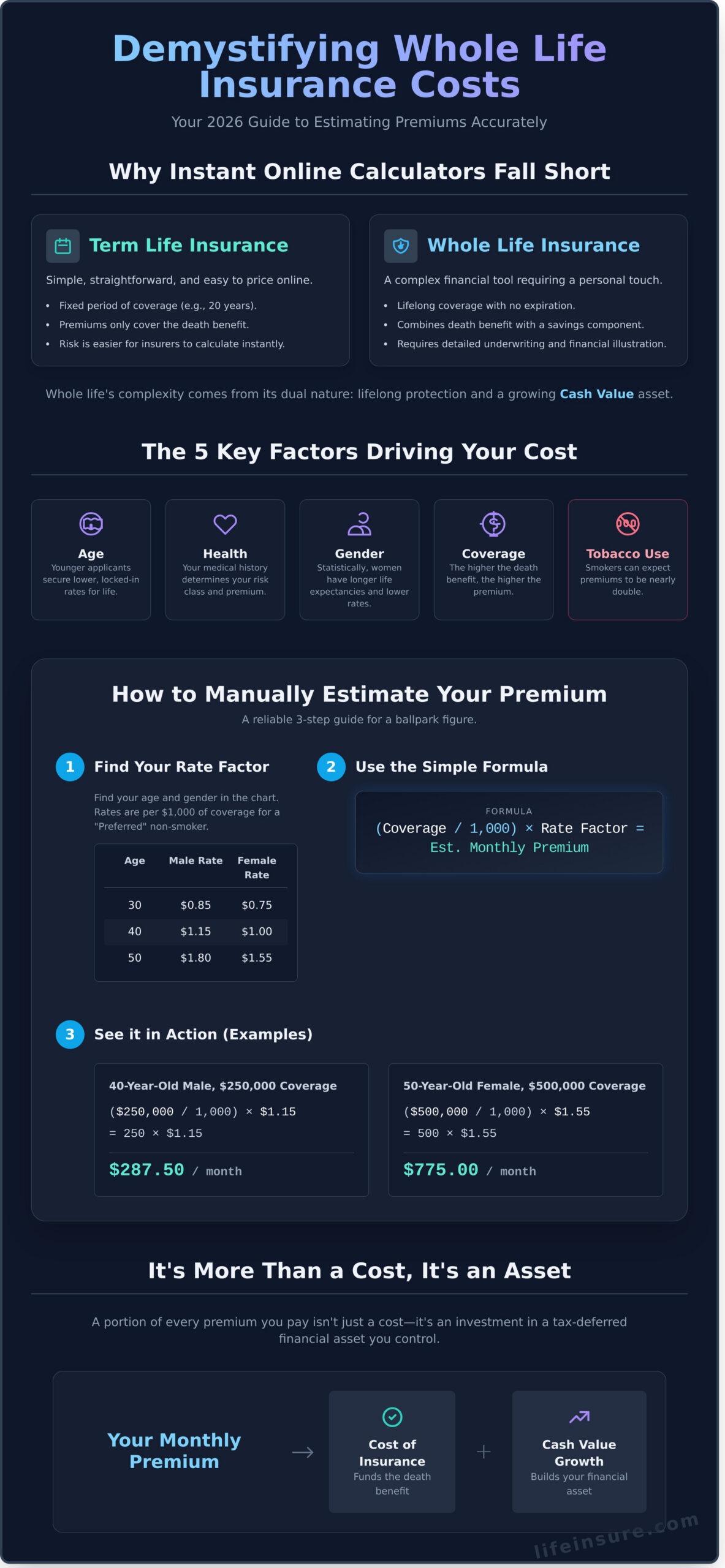
First, find the rate factor in the table below that most closely matches your age and gender. These sample rates are for a non-smoker in the “Preferred” health class, meaning an individual in excellent health with a favorable family medical history. These are illustrative monthly rates from top-rated insurers, shown on a per-$1,000-of-coverage basis.
| Age | Male Rate Factor | Female Rate Factor |
|---|---|---|
| 30 | $0.85 | $0.75 |
| 40 | $1.15 | $1.00 |
| 50 | $1.80 | $1.55 |
*Sample monthly premiums per $1,000 of coverage for a Preferred Non-Tobacco applicant. For estimation purposes only.
Step 2: Use the Simple Calculation Formula
Next, plug your desired coverage amount and the rate factor from the chart into this straightforward formula:
(Coverage Amount / 1,000) x Monthly Rate Factor = Estimated Monthly Premium
Let’s walk through two quick examples:
- Example 1: A 40-year-old male seeking $250,000 in coverage.
($250,000 / 1,000) x $1.15 = $287.50 per month
- Example 2: A 50-year-old female seeking $500,000 in coverage.
($500,000 / 1,000) x $1.55 = $775.00 per month
Step 3: Adjust for Your Specific Situation
This simple whole-life insurance calculator provides a solid baseline, but your personal situation will affect the final rate. For example, smoking can nearly double your premium. Adding policy riders, such as a long-term care benefit or a waiver of premium, will also increase the cost. These estimates provide a realistic starting point for budgeting.
Ready for a precise number based on your unique profile? Talk to an agent for a custom illustration.
The 5 Key Factors That Drive Your Whole Life Insurance Cost
A whole life insurance calculator provides an excellent starting point, but what do those numbers really mean? Understanding the core factors that insurers use to determine your premium empowers you to make a more educated decision. Think of these as the engine behind the calculator-the components that shape your final quote.
Personal Details: Age, Gender, and Health
This is the most personal part of your application, and it carries the most weight. Insurers are assessing risk, and your personal profile is their primary guide. You can’t change your age, but you can positively influence other areas.
- Age: This is the single most significant factor. The younger and healthier you are when you apply, the lower your premium will be for the life of the policy. Locking in a rate early provides a lifetime of savings.
- Health: Underwriters will review your medical history, current health, family history, and height-to-weight ratio. Making healthy lifestyle choices, such as maintaining a balanced diet and exercising, can improve outcomes.
- Tobacco Use: Using any form of nicotine, from cigarettes to vaping, will place you in a “smoker” category, which can increase your premiums by two to three times or more compared to a non-smoker.
Policy Details: Coverage Amount and Riders
The specifics of the policy you build have a direct, immediate impact on your costs. You have control over these choices, allowing you to balance your budget with your coverage needs.
- Death Benefit: The amount your beneficiaries will receive. It’s a straightforward calculation: a higher death benefit requires a higher premium.
- Policy Riders: Optional add-ons that customize your coverage. While they increase costs, they can provide valuable benefits. Common examples include a Waiver of Premium rider (which covers your premium payments if you become disabled) or an Accelerated Death Benefit rider (which allows you to access funds if you are diagnosed with a terminal illness).
Insurance Company and Policy Type
Finally, not all policies or providers are created equal. The company you choose and the specific type of whole life policy they offer play a crucial role in both cost and long-term value. This is why using a single company’s life insurance calculator isn’t enough.
Different insurers have unique underwriting guidelines, meaning one company might view your health profile more favorably than another. Furthermore, some policies are issued by mutual companies, which are owned by policyholders and may pay out annual dividends. These dividends can be used to increase your policy’s death benefit or its cash value. For a clear breakdown of this powerful feature, Investopedia provides a detailed explanation of cash value. Working with an independent agent lets you compare quotes from multiple top-rated carriers to find the best policy for your situation and budget.
Calculating the ‘Value’ in Cash Value Life Insurance
One of the most powerful-and often misunderstood- features of whole life insurance is its cash value component. Unlike term insurance, where your premium only covers the cost of the death benefit, a portion of your whole life premium is not a cost at all. It’s an asset you are building for yourself.
Think of it like paying a mortgage. Part of your monthly payment goes toward interest (the cost of the loan), while the other part builds your home equity. Similarly, with whole life insurance, part of your premium pays for the insurance protection, and the rest builds your policy’s cash value-a liquid asset you can use during your lifetime.
How Your Cash Value Grows
The cash value in your policy is designed for steady, predictable growth. A good whole life insurance calculator will project this growth based on a few key factors:
- Premium Contributions: A designated portion of every premium you pay is automatically added to your cash value account.
- Guaranteed Interest: Your cash value grows on a tax-deferred basis at a guaranteed minimum interest rate set by the insurance company. This provides a secure foundation for your policy’s growth.
- Potential Dividends: Many policies from mutual insurance companies are also eligible to earn non-guaranteed dividends, which can significantly accelerate your cash value accumulation.
Accessing Your Funds: Loans and Withdrawals
Your cash value is an accessible resource. You can take out a loan against your cash value, typically tax-free, for any reason-a down payment, a child’s education, or a medical emergency. It’s important to note that any outstanding loan balance will reduce the death benefit paid to your beneficiaries if the loan is not repaid. A withdrawal, on the other hand, is a permanent removal of funds and can have different tax implications.
Is Whole Life a Good Investment?
It’s best to view whole life insurance not as a high-growth investment like a 401(k) or an IRA, but as a highly conservative savings tool that comes with a built-in, tax-free death benefit. Its purpose is different. While traditional investments aim for maximum market growth, whole life provides stability, guarantees, and financial protection. It is an excellent tool for specific goals, like estate planning or supplemental retirement income, but it isn’t the right fit for everyone. To see if it aligns with your financial strategy, it helps to speak with an experienced agent.
Next Steps: From Calculator Estimate to an Official Quote
You’ve taken a crucial first step. The estimate from a whole life insurance calculator gives you a clear, data-driven starting point for your financial planning. But remember, this is an estimate, not a final offer. The next step is to bridge the gap between this initial number and a formal quote, a process that is straightforward and empowering when you know what to expect.
At LifeInsure.com, we believe in making this process transparent and stress-free. You’ll work directly with an experienced independent agent-not a call center-who will guide you every step of the way without any pressure.
Is Whole Life the Right Fit for You?
A whole life policy is a powerful tool for long-term goals like creating a legacy through estate planning, providing for a lifelong dependent, or maximizing your tax-deferred retirement savings. It’s designed for permanent needs. In contrast, term life insurance is built for temporary responsibilities, such as covering a mortgage or protecting your family until your children are financially independent. Not sure which is best? Compare instant term life quotes here.
Preparing to Speak with an Agent
To make your conversation as productive as possible, a little preparation goes a long way. Have the following ready:
- Your coverage estimate from the whole life insurance calculator and a comfortable monthly budget.
- A short list of specific financial goals you want the policy to help you achieve.
- Questions about the insurance company, such as its dividend payment history and policy loan features.
What to Expect During the Application Process
Once you decide to move forward, the formal application process begins. While it can take several weeks, your agent manages the details for you. The typical steps include completing the application, a brief phone interview to verify your information, and scheduling a free medical exam. Your agent’s job is to shop your application to find the best carrier for your unique situation, ensuring you get the most competitive and accurate final offer.
Beyond the Calculator: Secure Your Official Quote
As you’ve seen, while an instant whole life insurance calculator is appealing, these complex policies require a more personalized approach. Your premium is unique to you, shaped by key factors such as your health, age, and the policy design you choose. Understanding these variables provides a solid foundation for estimating your costs, but it’s only the first step toward securing your financial legacy.
The best way to see your real numbers and understand the long-term cash value is with a custom illustration. This is where an expert can make all the difference. Instead of a call center, you’ll work directly with an experienced independent agent who provides honest advice, not a sales pitch. They will help you compare policies from dozens of top-rated insurers to ensure you find the perfect fit for your goals. Ready to move from an estimate to a concrete plan?
Speak with an independent agent today for a personalized whole life illustration. Taking this step is a powerful move towards protecting your family and building long-term wealth, and we’re here to make the process clear and confident.
Last Updated on September 10, 2026 by Richard Reich
