

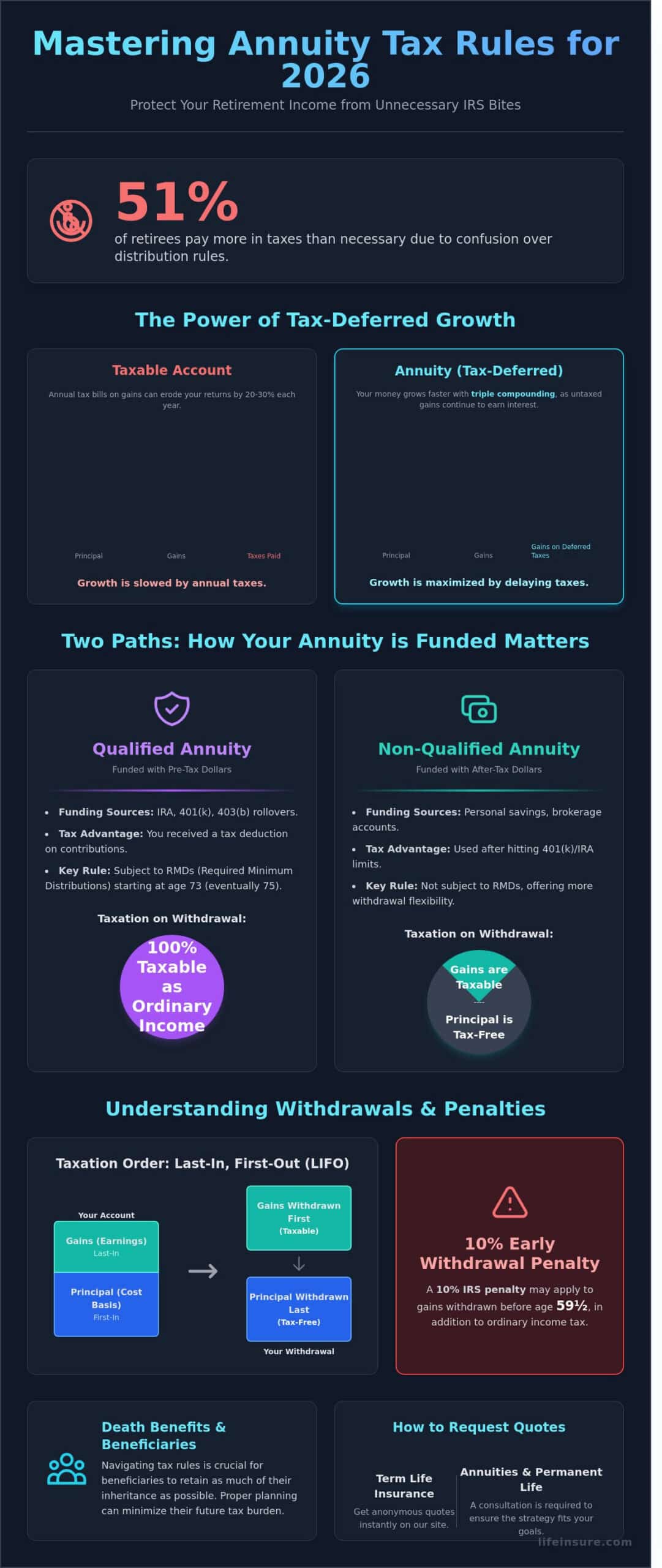
Did you know that 51% of retirees pay more in taxes than necessary simply because they don’t understand how their distributions are classified? It’s completely normal to feel overwhelmed when you see labels like “qualified” and “non-qualified” on your monthly statements. We understand that the fear of a 10% early withdrawal penalty can make you hesitant to touch your own money. Our goal is to help you master the annuity tax rules for 2026 so you can protect your retirement income from unnecessary IRS bites.
We want to make the quoting process transparent for all our visitors. While you can get term life insurance quotes on our site without providing any personal information, products like annuities, whole life, or disability insurance require your contact information up front. We need to have a thorough discussion with every prospect before quoting these products to ensure the strategy is right for your goals. This guide provides a clear preview of the exclusion ratio and a framework for comparing annuity tax benefits to life insurance. You’ll gain the knowledge needed to avoid penalties and keep your financial future secure.
Key Takeaways
- Discover how tax-deferred growth allows your principal to compound without annual tax hits, helping you maximize your long-term retirement savings.
- Identify the fundamental differences between qualified and non-qualified funding so you can accurately predict your future tax bill.
- Master the annuity tax rules governing “Last-In, First-Out” withdrawals to keep more of your money and avoid the 10% early distribution penalty.
- Learn how to navigate complex death benefit rules to ensure your beneficiaries retain as much of their inheritance as possible.
- We provide visitors with anonymous term life quotes, but for annuities, we require contact information up front so we can have a discussion with a prospect before quoting them.
Table of Contents
- Understanding Annuity Tax Rules and the Power of Tax-Deferred Growth
- Qualified vs. Non-Qualified Annuities: How Funding Sources Change Your Tax Bill
- Taxation on Annuity Withdrawals and the 10% Early Distribution Penalty
- Annuity Death Benefits: Tax Rules for Beneficiaries
- How to Request Annuity and Life Insurance Quotes: Managing Expectations
Understanding Annuity Tax Rules and the Power of Tax-Deferred Growth
We believe that clarity is the first step toward a secure retirement. Annuity tax rules are the specific guidelines set by the IRS that dictate how your money is treated while it grows, when you take it out, and how income streams are taxed. For 2026 retirement planning, we view these contracts as a powerful hybrid. They combine the growth potential of an investment with the safety net of an insurance policy.
One major difference between an annuity and a standard brokerage account is the annual tax paperwork. If you hold stocks or mutual funds in a taxable account, you likely receive a 1099-INT or 1099-DIV every January. You pay taxes on those gains even if you don’t spend the money. Annuities work differently. Your principal compounds without annual tax hits on interest or gains. This allows your balance to grow faster because money that would otherwise go to the IRS stays in your account to earn more interest.
We want to manage expectations regarding our quoting process. While visitors can get term life insurance quotes instantly without sharing personal details, annuities require a different approach. For annuities and products found on our permanent life insurance page, we require contact information up front. We need to have a discussion with a prospect before quoting them to ensure the specific annuity tax rules align with their long-term financial strategy.
The mechanics of tax deferral in 2026
The IRS allows your gains to remain untouched by taxes during the entire accumulation phase. Tax deferral is the legal delay of paying taxes on investment earnings until a future date, typically during retirement when the owner is in a lower tax bracket. If a visitor is in a 32% tax bracket today but drops to a 22% bracket in 2026 or beyond, deferring those taxes saves them 10% on every dollar earned. This strategy keeps more wealth in your pocket over time.
Annuities vs. Taxable Accounts: A growth comparison
High-net-worth visitors often prioritize annuities because of the triple compounding effect. Your money grows in three ways simultaneously:
- You earn interest on your original principal.
- You earn interest on your accumulated interest.
- You earn interest on the money you would have otherwise paid in taxes.
The insurance carrier tracks these gains internally but doesn’t report them as taxable income until you begin distributions. This is a stark contrast to bank CDs or taxable brokerage accounts, where taxes can erode your total return by 20% or 30% every single year. By using an annuity, you control the timing of your tax bill.
For ultra-high-net-worth clients, managing these tax implications across a diverse portfolio is a primary focus for multi-family offices like Neil Jesani Wealth.
Qualified vs. Non-Qualified Annuities: How Funding Sources Change Your Tax Bill
The way you fund your account dictates your future tax bill. We see many visitors get confused by the terminology, but the logic is straightforward. Understanding annuity tax rules starts with identifying if your money is “qualified” or “non-qualified.” This distinction determines whether the IRS treats your entire withdrawal as income or allows you to keep a portion tax-free.
Your cost basis is the most critical factor here. This term refers to the total amount of after-tax money you have contributed. For some prospects, the basis is zero. For others, it represents the majority of the account. Knowing this number helps us help you plan for a retirement without tax surprises.
Qualified Annuities: Rules for retirement plan rollovers
Qualified annuities are funded with pre-tax dollars. They usually live inside IRAs, 403(b) plans, or 401(k) rollovers. Because you received a tax deduction when the money went in, every dollar you take out is typically taxed as ordinary income. In 2026, the Required Minimum Distribution (RMD) age remains 73 for most retirees. However, under the SECURE 2.0 Act, the age will eventually increase to 75 by 2033. This Act also made it easier to include annuities in workplace plans by allowing for “increasing” payment options that were previously restricted.
Non-Qualified Annuities: The exclusion ratio explained
Non-qualified annuities are popular for prospects who have already hit their annual 401(k) or IRA contribution limits. You fund these with after-tax dollars, meaning you have already paid the IRS. When you start taking payments, the IRS uses an “exclusion ratio” to determine what is taxable.
- Return of Premium: A portion of each payment is treated as a return of your original principal and is not taxable.
- Earnings: Only the interest or growth portion of the payment is taxed as ordinary income.
- Gap Funding: Many use these as a bridge to cover expenses between early retirement and the start of Social Security at age 67 or 70.
We want to ensure you get the most accurate information for your situation. Unlike our term life insurance quotes, which you can access without sharing your name or email, annuities require a more personalized touch. Because these products have complex tax implications, we need to have a discussion with a prospect before quoting them. We will ask for your contact information up front so an experienced agent can walk you through the specifics of your cost basis and payout options.
Don’t let the complexity of annuity tax rules stop you from securing your future. We are here to simplify the process and act as your advocate. If you have questions about how a rollover might impact your 2026 tax strategy, please reach out to us for a clear, honest conversation.
Taxation on Annuity Withdrawals and the 10% Early Distribution Penalty
The IRS treats annuity withdrawals differently from most other investments. They use a method called “Last-In, First-Out” (LIFO). This means any money you take out is treated as taxable income first. Only after you’ve exhausted all the growth in the account can you access your original principal tax-free. For example, if a prospect invests $100,000 and the account grows to $145,000, the first $45,000 withdrawn is fully taxable as ordinary income. We want to help you understand these annuity tax rules so you don’t face unexpected bills in April.
State laws also play a role in how much you actually keep. California residents face an additional 2.5% state penalty on early distributions. In New York, while there isn’t a specific extra penalty, the state’s high-income tax brackets, which reached up to 10.9% in 2024, can significantly reduce your net payout. You should also be aware of the 10% federal penalty for withdrawing funds before age 59 ½. There are a few ways to avoid this, such as proving a total disability or a terminal illness diagnosis. Another option is using Substantially Equal Periodic Payments (SEPP), which allows you to take a specific amount annually based on your life expectancy without the penalty.
Avoiding the 10% penalty trap
Reaching age 59 ½ is the magic milestone for annuity owners. Once you hit this age, the federal penalty disappears. If you need to move your money before then, we recommend a 1035 Exchange. This allows you to swap one annuity for another without triggering a tax event. Many prospects make the mistake of taking a lump-sum distribution to move funds. This usually results in a massive tax bill. While you can get instant term life quotes on our site without sharing your name, we need to have a discussion with a prospect before quoting products like annuities or permanent life insurance. Because of this, we require contact information up front for these specific requests.
Surrender charges vs. IRS penalties
It’s easy to confuse insurance company fees with government taxes. A surrender charge is a fee the insurance company keeps if you cancel the contract too early. In contracts issued for 2026, these schedules typically last 7 to 10 years, often starting at 7% or 8% and decreasing by 1% annually. The IRS penalty is entirely separate from these fees. The IRS imposes a 10% additional tax on the taxable portion of annuity distributions taken before the owner reaches age 59 ½, unless a specific exception applies. Understanding these distinct annuity tax rules helps you plan a more efficient retirement strategy.
Annuity Death Benefits: Tax Rules for Beneficiaries
When an annuity owner passes away, the IRS doesn’t treat the remaining value like a standard inheritance. Unlike life insurance proceeds, which are generally tax-free under Internal Revenue Code Section 101(a), annuity gains are taxed as ordinary income to the beneficiary. This distinction is a vital part of annuity tax rules that every contract holder should understand. The tax burden depends heavily on who inherits the account and how they choose to receive the funds.
The IRS applies the “exclusion ratio” to death benefit payments. This means only the earnings are taxed, while the original principal is returned tax-free. However, if the annuity was held inside an IRA, the entire distribution is usually taxable. This creates a potential tax trap for heirs who aren’t prepared for a sudden jump in their annual income bracket.
The Spousal Continuation option
Surviving spouses have a unique advantage. They can choose “spousal continuation,” which allows them to step into the contract as the new owner. This keeps the tax-deferred status alive. It’s the most tax-efficient path for couples because it avoids an immediate tax bill. Most insurance companies require specific paperwork and a death certificate within 60 to 90 days to process this change. We’ve seen this option save families thousands in immediate tax liabilities.
Non-spousal beneficiary payout options
Non-spousal heirs face stricter requirements. They can’t maintain the tax-deferral indefinitely. Most must follow the “Five-Year Rule,” requiring them to liquidate the entire account and pay all associated taxes within five years of the owner’s death. While some non-qualified contracts still allow a “stretch” provision to spread taxes over a lifetime, the SECURE Act of 2019 and subsequent 2024 updates have significantly limited these options for retirement-based annuities.
Heirs often choose between a lump-sum distribution or annuitization. A lump sum is fast but triggers a massive tax hit in a single year. Annuitization spreads payments over time, which can keep the beneficiary in a lower tax bracket. Because of these complexities, we often recommend permanent life insurance policies for visitors focused primarily on building a tax-free legacy. Life insurance is simply more efficient for passing wealth to the next generation.
If you’re looking to protect your family’s future, we can help you compare options. You can get instant term life insurance quotes on our site without entering your name, phone number, or email address. For other products, such as whole life or disability insurance, we require your contact information up front. We need to have a direct discussion with prospects before quoting on these complex products to ensure the coverage aligns with your specific goals.
How to Request Annuity and Life Insurance Quotes: Managing Expectations
At LifeInsure.com, we believe you should lead the way. We provide the tools you need to make an educated decision at your own pace without feeling rushed or pressured. Our process is built on transparency; we’ve helped over 50,000 families find the right coverage since our founding. We use two distinct quoting paths based on the complexity of the product you need.
The ‘Instant’ Term Life Experience
Term life is straightforward. It’s often the right choice for visitors seeking simple, low-cost protection during their peak earning years. You can get term life insurance quotes in roughly 60 seconds without entering a name, phone number, or email address. We don’t believe in holding basic price data hostage. Our online engine pulls real-time rates from top-rated carriers, letting you compare costs instantly and privately.
Why Annuity and Disability quotes require a discussion
Products like permanent life insurance or annuities don’t fit into a one-size-fits-all box. Because annuity tax rules and disability insurance quotes depend on highly specific personal variables, we require contact information up front. We must have a discussion with a prospect before quoting to avoid providing misleading or inaccurate numbers. Factors such as your specific tax bracket, occupation, and long-term income goals can change the math significantly.
Our commitment to you is simple: no call centers. You’ll work directly with an experienced independent agent from start to finish. This personalized approach ensures your financial blueprint is accurate, protects your privacy, and addresses your unique 2024 financial goals.
Taking the next step
Preparing for your consultation is easy. We recommend having your current retirement account statements and a list of your legacy goals ready. During a 15-minute discovery call, we’ll identify which products align with your needs and explain how current annuity tax rules might impact your strategy. Contact us today to speak with an agent who understands the 2026 tax landscape and can help you secure your financial future.
Take Control of Your 2026 Financial Strategy
Navigating the complex annuity tax rules for 2026 requires a clear understanding of how the IRS treats your distributions. Remember that withdrawing funds before age 59.5 typically triggers a 10% early distribution penalty; staying informed helps you keep more of your hard-earned money. Whether you’re managing qualified retirement accounts or non-qualified funds, tax-deferred growth remains a powerful tool for building long-term wealth.
We’ve designed our quoting process to be as transparent as possible. While visitors can view term life insurance rates anonymously, we require contact information up front for annuities, whole life, and disability insurance. We believe it’s vital to have a direct discussion with every prospect before providing these specific quotes to ensure they meet your exact needs. You’ll always work with an experienced agent rather than a call center. We only provide options from A+ rated carriers to ensure your peace of mind. Let’s start building a secure plan to protect your family and assets for years to come.
Frequently Asked Questions
Are annuity payments considered earned income or ordinary income?
Annuity payments are taxed as ordinary income rather than earned income. You don’t pay Social Security or Medicare taxes on these distributions since they aren’t wages from a job. If you bought your annuity with post-tax dollars, the IRS only taxes the earnings portion at your current marginal tax rate. This rate ranges from 10% to 37%, depending on your total annual income.
What is the 1035 exchange rule for annuities?
The 1035 exchange rule allows you to swap an existing annuity for a new one without paying immediate taxes on the gains. Under Section 1035 of the Internal Revenue Code, this swap preserves your tax-deferred status. We help visitors navigate these transfers to ensure they meet the 100% direct rollover requirement. It’s a smart way to find a better interest rate without triggering a 20% or 30% tax bill today.
Can I avoid the 10% early withdrawal penalty if I am disabled?
Yes, you can avoid the 10% early withdrawal penalty if you meet the IRS definition of total and permanent disability. According to IRS Publication 590-B, this exception applies if a physician certifies that your condition will last at least 12 months or result in death. While you’ll still owe ordinary income tax on the earnings, the extra 10% penalty for being under age 59.5 is waived to provide financial relief.
How is a non-qualified annuity taxed upon death?
Beneficiaries pay ordinary income tax on the growth of a non-qualified annuity, but the original principal remains tax-free. If a visitor leaves a $100,000 annuity with $40,000 in earnings to an heir, the heir only pays taxes on that $40,000 portion. These annuity tax rules require the beneficiary to choose a payout method, such as the five-year rule or a lifetime stretch, which affects how quickly the IRS collects its share.
Do I have to pay taxes on an annuity if I roll it over from a 401(k)?
You won’t pay immediate taxes if you perform a direct rollover from a 401(k) into a qualified annuity. This process keeps your retirement funds in a tax-advantaged bubble until you start taking distributions. While you can get term life quotes without sharing personal info, we require contact details up front for annuity or disability products. We need to have a discussion with prospects first to ensure the rollover follows the strict 60-day IRS rule.
What is the exclusion ratio, and how do I calculate it?
The exclusion ratio determines the tax-free portion of each annuity payment based on your initial investment and life expectancy. To calculate it, we divide the total investment by the expected return. For example, if you invested $100,000 and the total expected payout is $200,000, your exclusion ratio is 50%. This means exactly half of every check you receive is a return of your own money and isn’t subject to government tax.
Are there any tax-free annuities available in 2026?
There aren’t completely tax-free annuities, but Roth annuities offer tax-free distributions if you’ve held the account for 5 years and are over age 59.5. In 2024, the IRS set contribution limits for IRAs at $7,000. By 2026, these limits might adjust for inflation. Following specific annuity tax rules ensures your growth remains protected. We require contact information up front for these quotes because we need to discuss your specific retirement goals.
Is the interest in a fixed annuity taxed every year?
No, the interest in a fixed annuity isn’t taxed every year because it grows tax-deferred. You only owe taxes when you actually withdraw the money or start receiving regular payments. This allows your interest to earn interest on money that would have otherwise gone to the IRS. We’ve seen visitors increase their long-term wealth by 15% or 20% simply by utilizing this deferral feature over several decades of saving.
Last Updated on August 7, 2026 by Richard Reich
