

Did you know that as of May 2026, the national median cost for a private nursing home room has climbed to $11,294 per month? It’s a staggering figure that explains why so many people worry about their savings disappearing. Understanding long term care insurance costs 2026 is no longer just an option for retirement; it’s a vital step to protect your financial legacy. We know the complexity of these policies can feel overwhelming, especially since the Federal Long-Term Care Insurance Program remains suspended until December 19, 2026. You deserve clear answers without high-pressure sales tactics.
We agree that the fear of outliving your assets is a heavy burden. That’s why we’ve designed this guide to provide a clear budget estimate and explain the critical differences between hybrid and traditional policy types. While we offer instant term life quotes without asking for your name or email, long-term care insurance is a specialized product. Because your health and age are the primary drivers of your premium, we require contact information upfront to provide an accurate quote for each prospect. This allows our experienced independent agents to have a direct, honest conversation with you. We’ll help you understand the $430 tax-free per diem limit and guide you toward a secure plan that fits your budget.
Key Takeaways
- Learn how the $135,528 annual median cost for nursing home care impacts your financial security and why early planning is essential.
- Discover why age and gender are the biggest factors in determining long term care insurance costs 2026 and how to lock in lower rates.
- Compare the differences between traditional policies and hybrid options that combine long-term care benefits with a death benefit.
- Find out how to secure discounts of up to 30% through couples’ applications and health-based incentives.
- Understand why we require a direct discussion with each prospect to ensure your long-term care quote is accurate and tailored to your specific health profile.
The Rising Cost of Care: Why LTC Planning is Critical in 2026
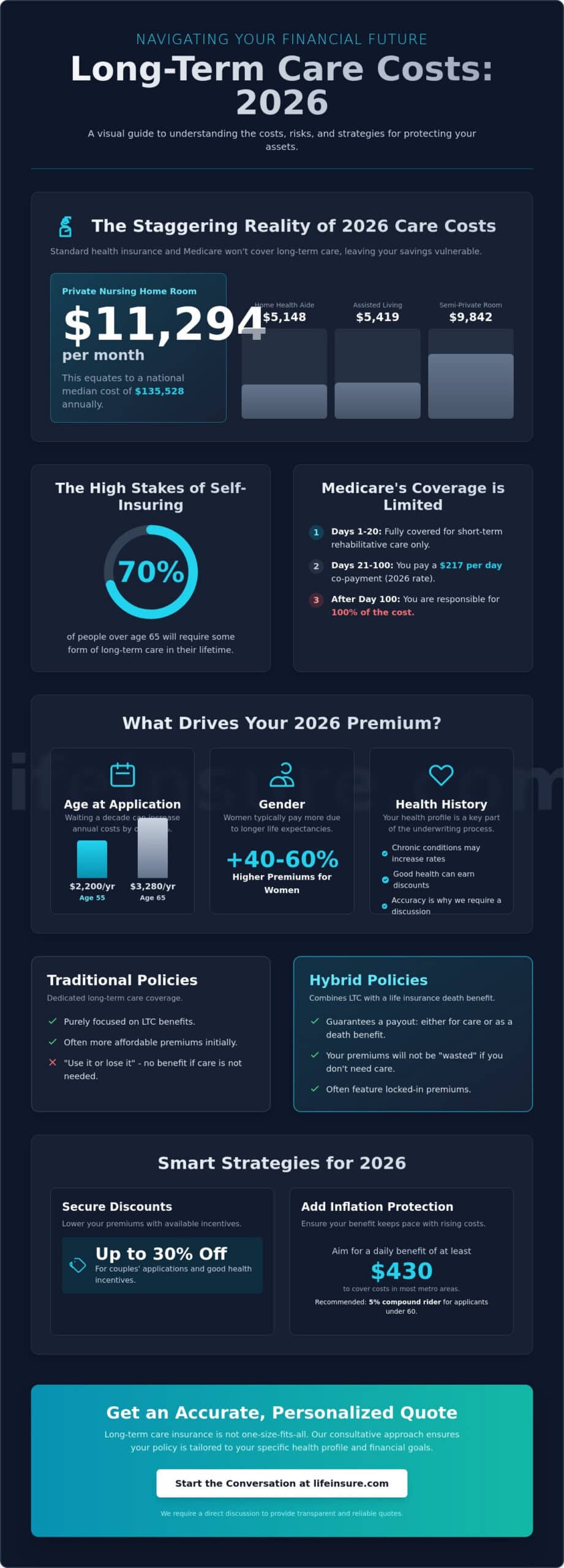
We define long-term care insurance as a proactive financial tool designed to cover the high costs of chronic care that standard health insurance and Medicare simply won’t touch. For 2026, the financial reality of aging has shifted significantly. A private room in a nursing home now carries a national median cost of $135,528 annually, or $11,294 every month. These figures represent a steep climb from previous years, making it harder for families to pay out of pocket without draining their life savings.
Many seniors mistakenly believe Medicare will provide a safety net. In reality, Medicare only covers short-term rehabilitative care. For 2026, the Medicare co-payment for nursing home care for days 21 through 100 is $217 per day; after day 100, you are responsible for the full cost. This “gap” leaves your assets vulnerable to a rapid burn rate. Waiting to address this risk carries an emotional and financial price. A single man who secures a policy at age 55 might pay $2,200 annually, but waiting until age 65 can spike that premium to $3,280 or more. We want to help you avoid these late-entry penalties by planning while you are still in good health.
2026 National Care Cost Estimates
The cost of care depends heavily on the setting you choose. In 2026, a home health aide costs a median of $5,148 per month, while assisted living facilities average $5,419 monthly. If skilled nursing is required, a semi-private room now costs $9,842 per month. Inflation has pushed the necessary daily benefit amount higher; in most US metro areas, you should aim for a daily benefit of at least $430 to ensure your expenses are fully covered in 2026.
The Risk of Self-Insuring
Attempting to self-insure can be a dangerous gamble with your retirement portfolio. Since 70% of people over age 65 will eventually need some form of long-term care, the likelihood of needing these funds is high. If your portfolio is generating a 4% withdrawal rate, a single year in a nursing home could represent several years of planned income. To protect your nest egg, you might consider learning about different life insurance policies that offer long-term care riders. Because these products are complex, we require a direct discussion with every prospect. Unlike our instant term life quotes, long term care insurance costs 2026 are highly personalized. We need to understand your health history and specific needs before we can provide an accurate, honest quote that you can rely on for your future security.
Key Factors That Determine Your 2026 LTC Insurance Premiums
The single largest driver of your monthly premium is your age when you sign the contract. As we discussed earlier, waiting just one decade can increase your annual costs by over $1,000. Gender also plays a massive role in the 2026 pricing landscape. Women typically pay 40% to 60% more than men because they statistically live longer and are more likely to require care for extended periods. For a detailed breakdown of these demographic trends, you can explore How Much Does Long-Term Care Insurance Cost? to see current market averages.
Your health history is the final piece of the underwriting puzzle. Chronic conditions such as diabetes or heart disease don’t just impact your eligibility; they can push you into a higher risk class with much higher rates. Because these factors are so personal, we provide a different experience than our instant term life quotes. We require contact information upfront for long-term care because we believe in transparency. We need to have a direct discussion with every prospect to ensure that the quotes we provide are accurate and based on your actual health profile. If you’re ready to start that conversation, feel free to contact one of our experienced agents today.
The Impact of Inflation Protection Riders
In 2026, inflation protection is more than just an add-on; it’s a necessity to keep pace with the $11,294 monthly cost of nursing home care. We generally recommend a 5% compound inflation rider for prospects under age 60 to ensure their daily benefit grows fast enough to be useful decades from now. If you are starting coverage in your late 60s or 70s, a 3% compound or even a “simple” inflation rider might be a more cost-effective way to manage your long term care insurance costs 2026 without sacrificing essential coverage.
The Elimination Period: Your “Deductible”
The elimination period is the number of days you must pay for care out of your own pocket before the insurance company begins to issue benefits. While a 30-day period sounds safer, it’s significantly more expensive than a standard 90-day period. You must weigh the risk of paying for those first three months against the permanent savings on your annual premium. Opting for a longer elimination period acts as a higher deductible, which significantly lowers your ongoing premium costs by reducing the insurer’s immediate risk. For many, the long-term savings on long term care insurance costs 2026 outweigh the initial out-of-pocket expense of a 90-day wait.
Comparing Traditional vs. Hybrid LTC Policy Costs
Choosing between a traditional policy and a hybrid model is one of the most important decisions you’ll make regarding long term care insurance costs 2026. Each path offers a different way to protect your assets, and the right choice depends entirely on your financial goals and your tolerance for premium changes. We want to help you understand these trade-offs so you can make an educated decision for your future.
Traditional LTC insurance is built for maximum efficiency. It’s often the best fit for individuals who want the highest daily benefit for the lowest initial premium. However, it’s vital to understand that these premiums are “guaranteed renewable,” which means they’re not strictly level. While a company cannot single you out for a rate increase, they can raise rates for a whole group of policyholders if they receive state approval. For those who prioritize a high daily benefit today and have some flexibility in their future budget, this remains a strong option.
Pros and Cons of Traditional LTC
The primary advantage of a traditional policy is that it offers the most benefit “bang for your buck” if rates stay stable. It’s the budget-conscious choice for those who want to maximize their daily care allowance. The downside is the history of rate increases seen in older policy blocks. We typically recommend this for prospects who want to leverage their current cash flow to buy the largest possible pool of benefits, even with the risk of future adjustments.
The Value Proposition of Hybrid Policies
In 2026, we’re seeing a massive shift toward hybrid policies. These plans combine long-term care coverage with permanent life insurance structures. The primary appeal is that they eliminate the “use it or lose it” risk. If you stay healthy and never need care, your beneficiaries receive a tax-free death benefit. Many of these policies also feature a “Return of Premium” rider, allowing you to get your money back if your circumstances change and you decide to cancel the coverage.
Hybrid policies typically require a higher upfront investment. You might choose a single lump-sum payment or a “10-pay” schedule where you finish paying for the policy in a decade. This provides total premium stability. Once it’s paid up, you never have to worry about a rate increase again. Because these products involve complex riders and various funding methods, we cannot offer instant online quotes like we do for term life insurance. To provide an accurate picture of long term care insurance costs 2026 for your specific situation, we need to have a direct discussion. We require contact information for every prospect because our experienced agents need to understand your health and financial goals before recommending a specific structure. You can Request a permanent life insurance quote to begin exploring these hybrid options with a member of our team today.
Strategies to Lower Your Long-Term Care Insurance Costs
Lowering your long term care insurance costs 2026 doesn’t always mean you have to settle for less coverage. In fact, some of the most effective ways to save involve smart planning and leveraging specific program rules. For example, applying for a policy alongside a spouse or partner can trigger couples discounts of up to 30% on your annual premiums. We also see that health incentives play a massive role in your final price. Securing a “Good Health” discount is statistically much easier in your 50s than in your 60s, as the likelihood of developing a disqualifying chronic condition increases with every passing year.
Because these discounts depend so heavily on your unique health profile and relationship status, we require contact information from every prospect before providing a quote. This process ensures that our experienced independent agents can have a direct discussion with you to find every available saving. Unlike our instant term life engine, long-term care requires a consultative approach to get the numbers right. If you want to see how these discounts apply to your situation, we invite you to speak with an agent today.
Leveraging State Partnership Programs
One of the most overlooked ways to manage long term care insurance costs 2026 is through State Partnership Programs. These programs offer a “dollar-for-dollar” asset protection feature. If you purchase a partnership-qualified policy and eventually exhaust your benefits, you can protect one dollar of your personal assets for every dollar the insurance company paid out. This unique feature allows you to buy a smaller, more affordable policy while still ensuring that your estate remains protected from Medicaid spend-down requirements. A Partnership Policy essentially creates a protected “nest egg” that is ignored when determining your Medicaid eligibility for future care needs.
Maximizing 2026 Tax Deductions
For the 2026 tax year, the IRS has confirmed significant age-based deduction limits for “tax-qualified” long-term care insurance policies. If you are age 70 or older, you can deduct up to $6,200 in premiums as a medical expense, provided your total medical costs exceed 7.5% of your Adjusted Gross Income. Business owners have even more flexibility; C-Corp owners and certain LLC members can often deduct 100% of their long-term care premiums as a legitimate business expense. These tax advantages effectively lower the “net cost” of your coverage, making it more affordable than the sticker price might suggest. We recommend verifying that your chosen plan meets the standards of IRC Section 7702B to ensure you qualify for these 2026 benefits.
Getting an Accurate Quote: Our Consultative Approach to LTC
We prioritize transparency above all else. While many websites offer generic price ranges, we believe that providing a “one-click” estimate for long term care insurance costs 2026 is misleading. Long-term care is a complex product that depends on your health, your family history, and your specific goals for the future. An automated engine can’t account for the nuances of your medical record or the specific inflation riders you might need to keep pace with rising nursing home expenses. To provide you with an honest and accurate quote, we require a direct discussion with each prospect.
Our “Privacy First” promise is the foundation of our service. We never sell or share your personal information with third parties. Your data is used exclusively by our experienced independent agents to research and compare top-rated carriers on your behalf. Unlike a call center where you might speak to a different person every time, you’ll work with a dedicated agent from start to finish. This personalized support ensures you aren’t just another number in a database; you’re a person making a critical decision for your family’s future security.
The Difference in Quoting Workflows
It’s helpful to understand how our process varies by product type. We offer instant term life insurance quotes without requiring your name, phone number, or email address. This works because term life is highly standardized. However, long-term care, disability insurance, and whole life policies involve much deeper underwriting requirements. Automated LTC quotes often fail because they skip the vital health screening questions that determine your actual risk class. By taking the time for a consultative discussion, we ensure the numbers we present are realistic and sustainable for your long term care insurance costs 2026 budget.
How to Prepare for Your LTC Consultation
Preparing for your session helps us find the best rates quickly. We recommend having a brief summary of your health history ready, including any medications or chronic conditions. Think about whether you prefer to receive care at home or in a facility, and have a general budget range in mind. During our typical 15-minute introductory call, we’ll listen to your goals and explain how different carriers view your specific profile. It’s a low-pressure, educational conversation designed to empower you with facts. If you’re ready to secure your future, contact us today to start your personalized LTC planning session.
Secure Your Financial Legacy and Care Today
Planning for your future needs is one of the most significant financial steps you can take. We’ve explored how a private nursing home room now averages $11,294 per month and why the State Partnership Program offers a vital safety net for your estate. By weighing the differences between traditional and hybrid policies, you can choose a path that balances premium stability with your specific goals.
Because long term care insurance costs 2026 are deeply personal, we don’t provide automated, generic quotes that might mislead you. Instead, we offer a transparent consultative process. As an independent brokerage, we compare top-rated US carriers to find your best fit. You’ll work directly with one of our experienced agents from start to finish. We never use impersonal call centers, and we’ll always respect your privacy. Are you ready to protect your hard-earned savings? Speak with an Experienced Agent for a Personalized LTC Quote today. Taking this step now ensures you stay in control of your care and your lifestyle. We’re here to help you move forward with confidence.
Frequently Asked Questions
Can my long-term care insurance premiums increase after I buy the policy?
Yes, premiums for traditional policies can increase if the insurer receives state approval for a specific class of policyholders. These policies are guaranteed renewable, which means the company cannot cancel your coverage, but they can adjust rates. If you want to avoid this risk, we often suggest hybrid policies that feature fixed, level premiums that are designed to never change.
Is long-term care insurance worth it if I already have a large 401(k)?
Even with a large 401(k), insurance acts as a shield for your retirement portfolio. With the 2026 national median cost of a private nursing home room reaching $135,528 annually, a three-year stay could deplete over $400,000 of your savings. We help you calculate the burn rate of your assets so you can decide if transferring that risk to an insurer makes more financial sense for your family.
What is the best age to buy long-term care insurance in 2026?
The ideal age to secure coverage is between 55 and 65. Purchasing earlier allows you to lock in lower premiums and take advantage of Good Health discounts that are harder to get later in life. Waiting until age 65 can increase your long term care insurance costs 2026 by more than $1,000 annually compared to buying at age 55. Because age is a primary factor, we require contact information upfront to provide an accurate quote for each prospect.
Does Medicare or Medicaid cover long-term care costs?
Medicare only covers short-term rehabilitative care for up to 100 days, with a $217 per day co-payment required for days 21 through 100 in 2026. Medicaid does cover long-term care, but only after you have exhausted almost all your personal assets. We focus on private insurance to ensure you maintain control over where you receive care without losing your estate to a Medicaid spend-down.
What happens to my hybrid LTC policy if I never need care?
If you never require care, a hybrid policy pays a tax-free death benefit to your beneficiaries. This feature eliminates the risk of paying premiums and receiving nothing in return. Because these products combine elements of life insurance and long-term care, we require a direct discussion with each prospect to tailor the benefit amounts. This consultative approach ensures your plan matches your legacy goals.
Are there any “no-exam” long-term care insurance options available?
While some simplified issue options exist, most top-rated carriers require a review of your medical records or a phone interview. Truly no-exam options are rare and often come with much higher premiums. We use an honest, consultative process to help you find carriers that offer the most streamlined underwriting based on your specific health history. We don’t use call centers, so you’ll work with the same experienced agent throughout the process.
How do I know if a long-term care policy is “Tax-Qualified”?
A policy is tax-qualified if it meets the federal standards outlined in IRC Section 7702B. This means the policy must be guaranteed renewable and cannot provide a cash surrender value. Most modern traditional policies meet these criteria, but some hybrid plans do not. We can help you identify which policies offer the best tax advantages for your 2026 filing during our initial discussion.
Can I use a Health Savings Account (HSA) to pay for LTC premiums?
Yes, you can use HSA funds to pay for tax-qualified long term care insurance costs 2026 up to specific IRS age-based limits. For individuals aged 70 or older, the 2026 deduction limit is $6,200. This is an excellent way to use pre-tax dollars to cover your insurance expenses. Because these rules are specific to your age and plan type, we need to understand your financial setup before providing a final quote.
Last Updated on July 27, 2026 by Richard Reich
