

What if you could see real life insurance rates without the fear of your personal data being sold to a dozen different call centers? Most people expect the life insurance application process explained to be a headache of invasive medical exams and endless follow-up calls. We know you want transparency, not a high-pressure sales pitch. Whether you’re looking for a $500,000 term policy, which averages about $53 per month for a healthy 40 year old in May 2026, or you’re planning for the federal estate tax exclusion dropping to $6.4 million this year, you deserve a clear path forward.
We’re here to help you master the journey from your first instant quote to your active policy. Our process is built on your terms; for term life insurance, you can see quotes instantly without sharing your name or phone number. For more complex needs like whole life, disability insurance, or long-term care, we’ll ask for your contact info upfront because a direct discussion with a prospect is necessary to ensure accuracy. This guide breaks down the modern application timeline, explains why certain data is needed, and gives you the confidence to start your journey with an experienced independent agent today.
Key Takeaways
- Discover how to access instant term life quotes without sharing your name, phone number, or email address.
- Compare simplified and traditional underwriting to choose between a fast, algorithm-based decision or a more thorough review for potentially lower premiums.
- Navigate the life insurance application process explained, including what to expect during the paramedical exam and how to prepare for your medical history review.
- Understand why complex products like disability insurance and permanent life policies require a brief consultative discussion with an agent before we provide a quote.
- Learn how to bridge the coverage gap by binding your policy, ensuring you have protection while the carrier finalizes your formal offer.
The Starting Point: Instant Quotes vs. Formal Applications
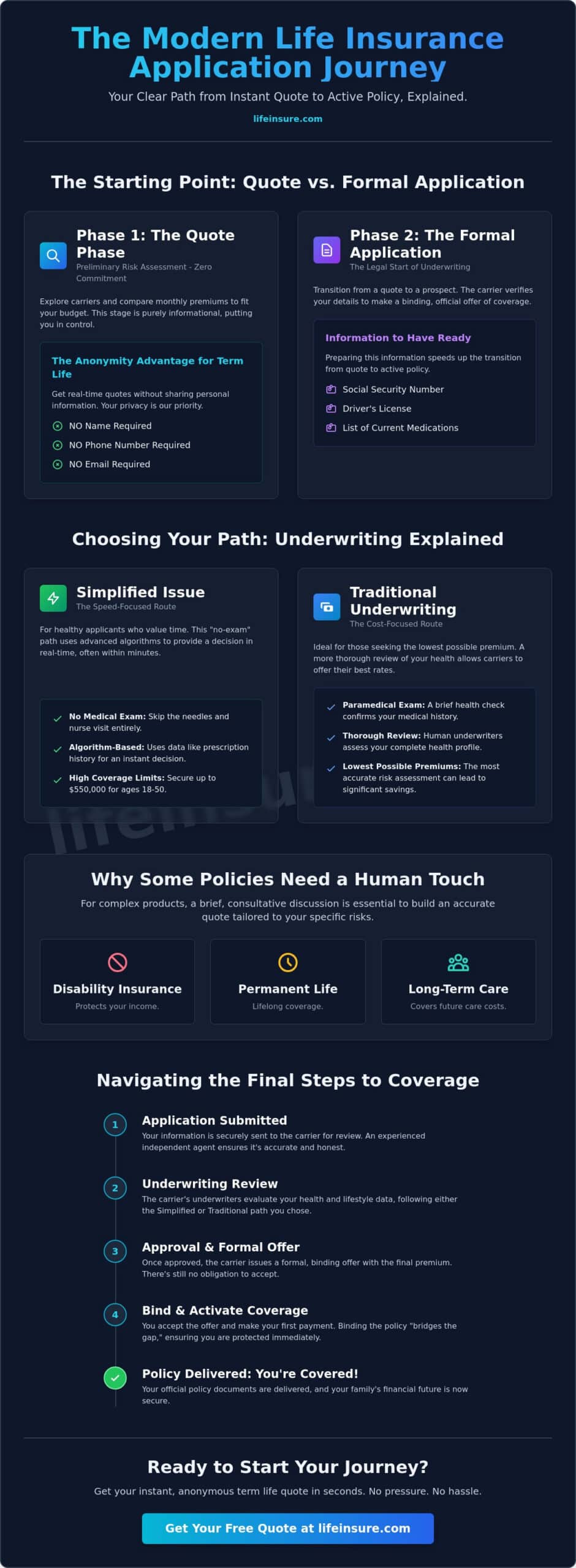
Most people think the life insurance application process explained begins with a phone call from a pushy agent. That’s not how we do things. We view the journey in two distinct stages: the Quote Phase and the Formal Application. The Quote Phase is a preliminary risk assessment. It’s purely informational. You’re exploring options, looking at monthly premiums, and seeing which carriers fit your budget. There is zero legal commitment at this stage. We believe you should know the market before you ever share your life story. While term life is simple to quote anonymously, more complex products like disability insurance or long-term care require your contact information upfront. We do this because a direct discussion with a prospect is necessary to build an accurate quote for those specific risks.
Contrast this with the Formal Application, which is the legal start of the underwriting process. While a quote gives you an estimate based on the data you provide, the application is where the carrier verifies your details to make a binding offer. We prioritize transparency because the industry often hides prices behind “lead forms” designed to capture your data. By separating these stages, we put the control back in your hands. You get to see the numbers first, allowing you to make an educated decision without feeling pressured to sign a contract before you’re ready.
The Anonymity Advantage for Term Life
For term life insurance quotes, we don’t ask for your name, phone number, or email. You just provide basic variables like your age, gender, and a general health class. This allows you to see real prices from top-rated carriers without your data being sold to a call center. Privacy-First Quoting is the ability to compare top-rated carriers without initial PII. We’ve found that this transparency reduces the anxiety of shopping for coverage. It’s a secure way to see that a $500,000 policy for a healthy 40 year old might only cost about $53 per month as of May 2026.
Transitioning from Quote to Applicant
Once you find a price that works, you move from curiosity to coverage. This is where you become a prospect in the eyes of the insurer. To speed this up, have your Social Security number, driver’s license, and a list of current medications ready. If you’re still deciding on the type of policy, check out What Is Term Life Insurance? A Simple Guide for Beginners for more context. This transition is the most critical part of the life insurance application process explained because it moves you from an estimate to a secure plan for your family. We stay with you as your experienced independent agent to ensure the data you submit is accurate and honest.
Choosing Your Path: Simplified vs. Traditional Underwriting
Underwriting is simply the method insurance carriers use to measure risk. They evaluate your health, lifestyle, and medical history to decide if they can offer you a policy and what your premium will be. In 2026, the life insurance application process explained has moved toward “Accelerated Underwriting.” This technology uses advanced algorithms to review data like your prescription history and motor vehicle records in real time. For many healthy applicants, this means you can skip the long wait times that used to define the industry. We help you choose the path that matches your health profile and how quickly you need your coverage to start.
We believe in setting clear expectations from the start. If you’re applying for term life, you’ve likely already seen our anonymous quotes. However, once you move into the underwriting phase, the carrier needs to verify that data. The choice between a “no-exam” path and a “fully underwritten” policy is the most important decision you’ll make during the application. One offers speed, while the other offers the lowest possible cost. We stay with you as your experienced independent agent to ensure you don’t overpay for the convenience of speed if a traditional route would save you more money in the long run.
Simplified Issue: The Speed-Focused Route
Simplified issue policies are built for people who value time. You skip the needles and the nurse visit entirely. As of April 2026, several top-rated carriers have increased their coverage limits for these digital paths. For example, if you are between the ages of 18 and 50, you can often secure up to $550,000 in coverage without a medical exam. For those aged 51 to 60, the limit is typically $450,000. You’ll complete a digital questionnaire that asks about your health history and lifestyle. It’s an excellent option for busy professionals, though it may come with a slightly higher premium than a fully underwritten policy.
Traditional Underwriting: The Cost-Saving Route
If you want the absolute lowest premiums available, traditional underwriting is the gold standard. This path involves a paramedical exam where a nurse visits your home or office to check your vitals and collect a blood sample. While this adds a few weeks to the life insurance application process explained, it provides the most accurate picture of your health. Carriers reward this transparency with their best rates. This is especially vital if you have a history of health issues or require high coverage amounts. If you’re unsure which route fits your budget, you can contact our team to discuss your specific health profile before you apply.
The Underwriting Deep Dive: From Medical Exams to Data Review
The life insurance application process explained often feels like a black box once you hit “submit.” After you move past the initial quote phase we discussed earlier, the real work begins. First, the online application captures your lifestyle choices, comprehensive medical history, and your chosen beneficiaries. This is a legal document, so accuracy is paramount. If you are applying for permanent life insurance or disability insurance, we have likely already guided you through the specific data requirements during our initial consultation. This direct discussion ensures that the underwriter has the context they need to assess your occupation or income protection needs accurately.
Next comes the paramedical exam. This is a common hurdle for many, but it is a standard part of traditional underwriting. A mobile nurse meets you at your home or office to check your height, weight, blood pressure, and pulse. They will also collect small blood and urine samples. These samples are vital because they reveal your cholesterol levels, glucose, and any traces of nicotine or medications. While this sounds invasive, it is the most reliable way for carriers to offer you the lowest possible rates based on your actual health rather than just an estimate.
Preparing for the Paramedical Exam
To ensure your vitals are optimal on the day of the exam, we recommend fasting for at least eight hours and avoiding caffeine or strenuous exercise for 24 hours prior. Drink plenty of water to stay hydrated, which helps with blood collection and urine samples. The insurance carrier pays for the entire paramedical exam, so there is no out-of-pocket cost to you as the applicant.
Behind the Scenes: The MIB and Prescription Checks
While you wait for your lab results, the carrier performs a third-party data review. They check the Medical Information Bureau (MIB) records, which act like a “credit report” for your health history to prevent fraud. They also access digital prescription databases to verify any medications you have taken over the last five to seven years. These digital tools significantly speed up the life insurance application process explained by providing underwriters with verified data in seconds. Honesty is critical here; non-disclosure of a medical condition or a prescription is the number one cause of claim denials later on. If the data triggers a red flag, a human underwriter steps in to perform a manual review of your risk profile.
Finally, the underwriter assigns you a health class. These typically range from “Preferred Plus” for those in excellent health to “Standard” or “Rated” for those with specific health risks. A healthy 40-year-old non-smoker might expect a Preferred rate for a $500,000 term policy, which costs approximately $53 per month as of May 2026. Once the underwriter completes their review, we present you with the final offer, moving you one step closer to active coverage.
Why Complex Policies Require a Consultative Approach
While the life insurance application process explained for term policies is often instant and anonymous, complex products follow a different path. We believe in transparency, and that means being upfront about why we don’t offer “one-click” quotes for permanent life insurance policies or disability coverage. These products aren’t just about a death benefit; they involve cash value components and specific occupational definitions that require expert design. For these insurance types, a direct discussion with a prospect is necessary. We need your contact information upfront to ensure the numbers we provide are accurate and tailored to your financial goals. Working with an experienced independent agent is a consultative experience, not a high-pressure sales call from a random call center.
We prioritize your privacy, but we also prioritize accuracy. If we gave you a generic quote for a complex product without knowing your specific needs, we would be doing you a disservice. By gathering your data early, we can filter through dozens of carriers to find the one that views your specific risk profile most favorably. This tailored approach is why our clients feel confident when they finally move from the quote phase to the formal application.
The Permanent Life Insurance Workflow
Permanent products like “Whole Life” or “Universal Life” are significantly more intricate than term life. For instance, a 40-year-old individual pays an average of $557 per month for a whole life policy as of May 2026. Because these policies serve as long-term financial tools, we require a permanent life insurance quote request before showing any numbers. We need to create personalized illustrations that show how your cash value grows over decades. The approval timeline for these policies usually takes 4 to 8 weeks because the underwriting review is more intensive than a standard term policy.
Income Protection: The Disability Insurance Process
Protecting your income is just as vital as protecting your life. We specialize in providing disability insurance quotes for high-earning professionals like physicians and attorneys. For these clients, the “own-occupation” definition is the most critical part of the contract. It ensures you receive benefits if you can’t perform your specific specialty, even if you can work in another field. This level of detail requires a consultative interview to capture your exact duties and income. Unlike an impersonal call center, our agents stay with you from that first call to the final signature. If you’re ready to protect your future, you can request a personalized consultation with our team to get started.
Navigating the Final Steps: Approval, Binding, and Delivery
The life insurance application process explained wouldn’t be complete without discussing the finish line. Once the underwriting review is finished, the carrier issues a formal offer. In many cases, this offer matches the quote you saw during your initial search. However, if the medical exam or third-party data revealed new information, your final rate might be higher than the estimate. If this happens, don’t panic. As your independent agent, we review the underwriter’s notes with you and can even shop your file to other carriers to see if a better offer is available elsewhere. You are never forced to accept a policy that doesn’t fit your budget.
Accepting the offer leads to “Binding Coverage.” This is a critical legal step. Binding means you have established temporary or permanent protection while the final policy is being generated. To bind the company’s liability, you must sign the final offer and make your first premium payment. Most carriers in 2026 have moved entirely to digital e-delivery. This means instead of waiting for a thick envelope in the mail, you receive a secure link to your policy. You can review, sign, and store your documents in minutes, ensuring your family is protected immediately.
Accepting Your Offer and Binding Coverage
We make the final paperwork easy by using secure digital tools like DocuSign. You can sign your documents from your phone or computer without ever needing a printer. Once you’ve signed, you’ll set up your first premium payment. This payment is what officially puts the coverage in force. If you are a high-risk applicant and receive a decline, our strategy changes. We work with you to find specialized high-risk life insurance carriers that focus on your specific health profile, ensuring you aren’t left without options. We treat every prospect with the same level of care, regardless of the underwriting outcome.
The Peace of Mind Phase
Every new policy comes with a “Free Look Period.” This is typically a 10 to 30 day window where you can cancel the policy for any reason and receive a full refund of your premium. It’s a consumer protection designed to give you total confidence in your choice. Once you are satisfied, store your digital policy in a secure location and inform your beneficiaries. They should know which carrier holds the policy and how to contact us if they ever need to file a claim. Life changes fast, so we recommend an annual review of your coverage to ensure it still matches your financial needs, especially as tax laws or income levels shift.
Ready to see your options? Get your instant term quotes here without sharing your personal info. If you need help with more complex needs like whole life or disability coverage, contact an agent today for a transparent, consultative discussion.
Take Control of Your Coverage Today
You now have the life insurance application process explained from the very first anonymous quote to the moment your digital policy is delivered. You understand the choice between the rapid speed of accelerated underwriting and the significant cost-savings found in traditional medical exams. We’ve built our platform on a privacy-first promise, allowing you to compare quotes from 40+ top-rated carriers without ever entering your name or phone number for term life insurance. For more complex products like whole life or disability insurance, we provide the same transparency through a consultative approach that ensures your policy is designed correctly from day one.
Don’t let the fear of complexity or invasive questions keep you from protecting what matters most in 2026. When you work with us, you’ll partner with an experienced independent agent who stays by your side throughout the journey, not an impersonal call center. Whether you are planning for the new $6.4 million estate tax exclusion or simply want to cover your mortgage, the path is now clear. It’s time to move from curiosity to active protection with a team you can trust.
Get Instant Term Life Quotes Without Sharing Personal Info
We look forward to helping you secure your family’s financial future with honesty and ease.
Frequently Asked Questions
How long does the life insurance application process take in 2026?
Accelerated underwriting provides decisions in minutes or hours for healthy individuals. Traditional underwriting for products like whole life still takes between 4 and 8 weeks for final approval. The life insurance application process explained in this guide highlights that your specific health profile and the complexity of the policy determine this timeline. We work to move your application through the system as quickly as possible.
Can I apply for life insurance without a medical exam?
You can absolutely apply without a medical exam through simplified issue paths. As of April 2026, many carriers offer up to $550,000 in coverage for applicants aged 18 to 50 without requiring a nurse visit. These policies rely on digital data and your answers to health questions instead of blood samples. It’s an excellent way to secure protection without the wait or the needles.
What questions will I be asked on a life insurance application?
Carriers ask about your medical history, current medications, and lifestyle choices like smoking or dangerous hobbies. You’ll also need to name your beneficiaries and provide financial details if you’re applying for high coverage amounts. For disability insurance, we’ll need to discuss your specific job duties in detail. This ensures that every prospect receives a policy that accurately reflects their unique risk profile.
What happens if my life insurance application is denied?
If your application is denied, we don’t give up on your coverage. We review the carrier’s specific reasons for the decline and look for a high-risk life insurance provider that specializes in your condition. Having an experienced independent agent is vital here because we know which carriers are more lenient for certain health risks. We’ll guide you through the next steps to find a secure alternative.
Do I have to provide my social security number on the application?
You must provide your Social Security number once you move from the quote phase to the formal application. This is required for the carrier to verify your identity and check your medical records. However, we never ask for this sensitive data just to show you initial term life prices. We prioritize your privacy and only request this information when it’s legally necessary for the underwriting process.
Can I change my coverage amount after I have already applied?
You can usually adjust your coverage amount while your application is still in the underwriting phase. If you decide you need more protection, the carrier might require additional medical data or a higher premium. It’s much easier to make these changes before you sign the final delivery documents. We’ll help you communicate these adjustments to the carrier to keep the life insurance application process explained moving forward.
What is ‘binding coverage’ and when does it start?
Binding coverage is temporary protection that starts after you sign the application and pay the first premium. It ensures your family is protected while the insurance company finishes the final review. This is a crucial step in the life insurance application process explained because it bridges the gap between applying and full policy issuance. It provides immediate peace of mind while the details are finalized.
Why does disability insurance take longer to approve than term life?
Disability insurance takes longer because the carrier must verify your income and analyze your specific occupational risks. Unlike term life, which focuses mostly on mortality, disability coverage protects your ability to work. This requires a more intensive review of your financial records and job responsibilities to ensure the quote is accurate. A direct discussion with a prospect is necessary to define these specific occupational duties correctly.
Last Updated on July 30, 2026 by Richard Reich
