

With average dental school debt reaching $293,900 for recent graduates, your hands are quite literally the most expensive tools you own. You already know that the repetitive physical strain on your neck, back, and wrists is an occupational hazard that could sideline your career at any moment. It’s stressful to think that one minor hand injury could jeopardize your ability to service those loans or support your family. We want to help you secure your future with specialized dentist disability insurance that addresses these exact pressures.
In this 2026 guide, you’ll discover how to obtain a "True Own-Occupation" policy and why standard ADA group plans might leave you exposed. It’s important to note that while we provide instant term life quotes without requiring personal info, disability insurance works differently. We require your contact information up front because we need to have a discussion with a prospect before quoting them. This personalized step allows us to tailor the coverage to your specific clinical duties and financial goals. By the end of this article, you’ll understand exactly how to protect your income and choose a policy with a cost-to-benefit ratio that makes sense for your practice.
Key Takeaways
-
Recognize why the high-dexterity demands of dentistry require specialized protection against the statistical reality that one in four dental professionals will face a disability.
-
Evaluate essential policy features like "Own-Occupation" definitions and residual benefits to ensure your income is protected even during a partial return to work.
-
Compare the portability and security of individual policies against the potential risks of group or association plans to find the right fit for your long-term career.
-
Learn how to budget for your professional safety net using the 1% to 3% rule, and identify the specific factors that determine your coverage costs.
-
Understand why we prioritize a personal discussion up front to provide an accurate dentist disability insurance quote that is tailored to your unique financial and clinical needs.
Table of Contents
Why Dentists Need Specialized Disability Insurance
Dentistry is a high-dexterity profession where your hands are your most valuable tools. Unlike many office-based roles, even a minor injury can end a career overnight. A slight tremor, a ligament tear in the wrist, or a slight loss of sensation in the fingertips might not stop a corporate executive from working, but they make clinical dentistry impossible. We see this reality often when consulting with dental professionals. You are essentially a high-earning manual laborer who relies on microscopic precision to perform your daily tasks.
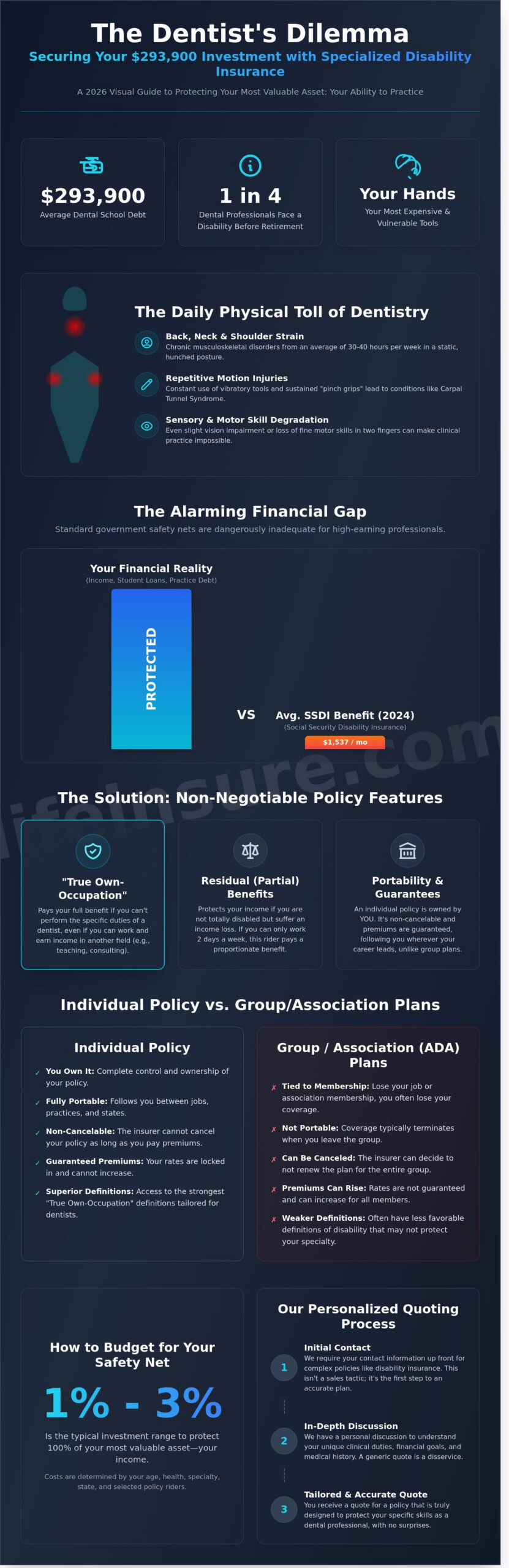
The statistical risk is higher than most people realize. Data from the Council for Disability Awareness shows that one in four dental professionals will face a disability that keeps them out of work for 90 days or more before they reach retirement. This isn’t just a vague possibility; it’s a significant financial threat. Getting the right dentist disability insurance is about more than just receiving a monthly check; it’s about protecting the decade of training and the massive financial investment you’ve made in your career.
The Physical Toll of the Dental Profession
The daily demands of clinical practice put immense strain on the human body. Dentists spend an average of 30 to 40 hours per week in a static, hunched posture while performing intricate movements in a confined space. This leads to chronic musculoskeletal disorders. Back, neck, and shoulder pain are the most common physical complaints in the industry. Repetitive motion injuries, such as carpal tunnel syndrome, frequently occur due to the constant use of vibratory tools and the sustained "pinch" grip required for scaling and drilling.
Beyond ergonomics, sensory health is paramount. If you experience vision impairment or lose fine motor skills in even two fingers, your ability to perform surgery or restorative work vanishes. Standard Disability Insurance policies often use broad definitions of disability that may not account for these specific professional nuances. This is why specialized coverage is a necessity rather than a luxury.
Financial Vulnerability: Debt vs. Income
The average dental student graduates with $290,000 in debt, according to 2023 data from the American Dental Education Association. When you factor in the costs of owning a practice, such as equipment leases and payroll, the financial stakes are incredibly high. Disability insurance is a vital income protection tool that ensures high-debt professionals can meet their financial obligations if they can no longer practice. Relying on Social Security Disability Insurance (SSDI) is a dangerous strategy for high earners. The average monthly SSDI benefit in 2024 is approximately $1,537, which won’t even cover the interest on a typical dental school loan or a monthly practice mortgage.
We want to be clear about how our quoting process works for different products. While our visitors can get term life insurance quotes instantly without entering a name or email, the process for dentist disability insurance requires contact information up front. This is because these policies are highly complex and must be tailored to your specific specialty and medical history. We need to have a discussion with a prospect before quoting them to ensure the policy includes the correct riders and definitions. This personal approach ensures you get an accurate quote that truly protects your specialized skill set. Our experienced independent agents work with you from start to finish to find the right fit for your practice.
Essential Policy Features for Dental Professionals
We believe in total transparency regarding how we provide quotes. If you are searching for term life insurance, you can view instant rates on our site without sharing your name, phone number, or email address. However, for dentist disability insurance and other complex products like whole life or long-term care, we require your contact information up front. This is because these policies are highly technical; we need to have a discussion with every prospect to ensure the coverage matches their specific clinical duties and income level. A generic quote often leads to a false sense of security, so we prioritize accuracy through a personal consultation.
Private coverage is designed to fill the massive gaps left by government safety nets. The Social Security Administration maintains very strict definitions of disability that often require a total inability to work any job at all. For a high-earning dentist, this baseline is rarely sufficient. You need a policy that recognizes the physical precision required for your specific role. We focus on four core features that transform a basic policy into a professional-grade safety net.
-
Residual and Partial Disability Benefits: These are essential for a phased return to work. If an illness allows you to work only 15 hours a week instead of 40, these benefits pay a portion of your monthly sum to cover the lost income.
-
Cost of Living Adjustments (COLA): With inflation rates sitting at 3.4% as of late 2023, your purchasing power can erode quickly. A COLA rider ensures your monthly benefit increases annually to keep pace with the economy.
-
Future Purchase Options: As your practice grows and your income climbs from $150,000 to $400,000, this feature lets you buy more coverage without another medical exam.
The "True Own-Occupation" Standard
This is the most critical definition in dentist disability insurance. Most standard policies use an "any occupation" definition, meaning if you can work as a telemarketer or a librarian, the insurer won’t pay. True Own-Occupation is different. It states that if you cannot perform the specific duties of your dental specialty, you are considered totally disabled. This remains true even if you choose to work in another field. For example, an endodontist who develops a hand tremor can no longer perform root canals. Under this definition, they could transition into teaching at a dental school, earn a full salary there, and still collect their full disability benefit. It protects your investment in your specialized education.
Student Loan Protection Riders
The average dental school graduate enters the workforce with roughly $293,000 in student loan debt, according to 2023 data. If a disability strikes early in your career, those payments don’t stop. A student loan protection rider is a specialized add-on that pays your lending institution directly during a period of disability. This is vital because it prevents your base monthly benefit from being consumed by debt payments. We typically recommend matching this rider’s duration to your specific loan term, such as 10 or 15 years. This ensures your mortgage and grocery budget remains intact while your education debt is handled separately. If you want to see how these riders fit into a broader plan, you can request a personalized consultation with one of our experienced agents today.
Comparing Individual Policies vs. Association (ADA) Plans
Choosing between an individual policy and an association plan, such as those offered by the ADA, is one of the most critical financial decisions a practitioner makes. We often see prospects drawn to association plans because of the low initial cost. However, these group policies carry hidden risks that can jeopardize your long-term security. Individual dentist disability insurance provides a level of certainty that association plans simply cannot match. The most vital difference lies in the "Non-Cancelable" and "Guaranteed Renewable" provisions. In an individual policy, these clauses ensure the insurance company cannot change your premiums, reduce your benefits, or cancel your coverage as long as you pay the premiums. Association plans typically lack these guarantees, meaning the board can increase rates for the entire group or even terminate the master contract.
Portability and Control
Ownership of the contract is a major point of contention between these two options. With an association plan, the association board holds the master policy. They decide the terms, the definitions of disability, and which riders are available. If you decide to leave the association or if the association chooses a different carrier, your coverage could change or disappear entirely. Individual policies put you in the driver’s seat. You own the contract, and it stays with you regardless of your membership status or where you practice. This portability is essential for dentists who may transition from an associate role to practice ownership or move across state lines.
Individual plans also offer a level of customization that group plans lack. You can add specific riders, such as a Cost of Living Adjustment (COLA) or a Future Increase Option, that allow you to buy more coverage as your income grows without a new medical exam. For comprehensive protection, specialized coverage should safeguard your personal income and business loans, regardless of your specific employment arrangement. We believe you should have total control over the policy that protects your greatest asset: your ability to work.
Underwriting and Premium Structure
The way premiums are calculated differs significantly between these two paths. Association plans often use "age-banded" premiums. This means your rates start low but jump significantly every five years, usually at ages 30, 35, 40, and so on. By the time you reach your peak earning years in your 50s, the "cheap" association plan often becomes more expensive than an individual policy. Individual dentist disability insurance uses level premiums. You lock in a rate based on your age and health at the time of application, and that rate stays the same until you retire. In a 2023 cost analysis, a 32-year-old dentist who locked in a level premium saved over $42,000 in total premiums by age 65 compared to an escalating age-banded plan.
We want to be transparent about how we provide information to our visitors. While you can get instant term life quotes on our site without sharing any personal details, disability insurance is different. We require your contact information up front for these requests. This is because we need to have a discussion with a prospect before quoting them. Every dental specialty has a different risk profile, and we want to ensure that the definitions of "own-occupation" disability are accurate for your specific daily tasks. To start this process, please visit our disability insurance quotes page for a professional evaluation. Locking in coverage while you are young and healthy is the most effective way to guarantee the lowest possible long-term cost.
Calculating the Cost of Coverage in 2026
Calculating your premium for dentist disability insurance starts with a simple benchmark. Most dental professionals should budget between 1% and 3% of their gross annual income for high-quality coverage. For a practitioner earning $250,000, this translates to an annual premium of $2,500 to $7,500. This investment secures your most valuable asset: your ability to perform clinical work and generate revenue over a thirty-year career.
We want to be transparent about how we provide these figures. You can get term life insurance quotes on our site without entering your name or email. However, for dentist disability insurance, we require your contact information up front. We need to have a discussion with a prospect before quoting them because these policies are highly customized to your specific role, medical history, and clinical duties. This personalized approach ensures you don’t pay for coverage that doesn’t fit your unique situation.
Several variables shift your costs within that 1% to 3% range. The elimination period is the waiting time before benefits begin. Choosing a 90-day period instead of a 30-day period can reduce your premium by 25% or more. Benefit periods also play a major role. While lifetime benefits were common decades ago, most modern policies in 2026 cover you until age 65 or 67. Selecting age 67 aligns with current Social Security normal retirement ages and provides a robust safety net without the extreme costs of a lifetime rider.
Specialty-Specific Rating Classes
Insurance carriers group dental professionals into occupational classes based on the physical demands and risks of their work. General dentists often fall into a Class 5 or 6, which offers the most competitive rates. In contrast, oral surgeons and endodontists frequently fall into Class 3 or 4 because their procedures are more physically demanding and require highly precise fine motor skills. Gender also influences the math significantly. Data from 2025 shows that women often pay 40% more than men for the same disability coverage due to higher historical morbidity rates. If you own a practice, we can often secure a 15% discount by setting up a multi-life policy for three or more employees, which lowers the cost for everyone involved.
Optimizing Your Premium
You don’t have to choose the most expensive plan to be safe. Balance your elimination period with your liquid cash reserves. If you have three to six months of expenses in a high-yield savings account, a 90-day elimination period is the most cost-effective choice. The elimination period acts as a deductible for your time. When calculating your monthly benefit, focus on your after-tax needs rather than your total gross income. Since most individual dentist disability insurance benefits are tax-free, you may only need to cover 60% of your current salary to maintain your current lifestyle. This strategy keeps your premiums manageable while still providing a complete financial recovery plan if you’re unable to practice.
Ready to protect your future income? Request a personalized disability insurance quote from an experienced agent.
How to Get an Accurate Disability Insurance Quote
Getting an accurate quote for dentist disability insurance requires a level of detail that an automated algorithm simply cannot provide. While technology has made many parts of our lives instant, specialized professional coverage requires a more nuanced approach. We prioritize accuracy over speed because a ballpark figure that ignores your specific dental specialty is useless when you actually need to file a claim. We want to ensure the numbers you see are the numbers you’ll actually pay.
The Consultation-First Approach
We don’t provide "blind" or instant quotes for disability insurance. This is a deliberate choice designed to protect our prospects. Unlike buying a standard commodity, your policy must be tailored to your specific clinical duties. Are you an endodontist performing microsurgery or a general dentist focused on extractions? The physical demands differ significantly. We need to match your daily tasks to the right carrier’s definition of "own occupation" to ensure you’re fully protected.
Managing expectations regarding the timeline is also vital. Typically, the process from our first discussion to a formal policy issuance takes between 30 and 60 days. This duration allows for a thorough review of your medical history and financial records. This personalized strategy ensures that your dentist disability insurance policy actually pays out when you need it most, rather than leaving you with coverage gaps during a crisis.
Why Disability Quoting Differs from Life Insurance
Visitors to our site often notice they can get term life insurance quotes instantly without entering a name, phone number, or email address. We love providing that level of privacy for life insurance because the underwriting is often more straightforward. However, for disability products, we require contact information up front. We must have a detailed discussion with every prospect before quoting. This isn’t about sales pressure; it’s about underwriting reality.
Disability underwriting involves evaluating your income, your specific occupational class, and your health history simultaneously. A generic quote would likely be 25% to 40% off the actual premium once a carrier sees your full profile. By having a conversation first, we avoid the frustration of "bait and switch" pricing that occurs with automated quote engines. We want you to feel empowered and informed, not surprised by a price hike three weeks into the application process.
To prepare for our discussion, we recommend having a few documents ready:
-
Your most recent two years of tax returns, specifically Form 1040 and any Schedule C or K-1 documents.
-
A current breakdown of your monthly business overhead expenses if you’re a practice owner.
-
When gathering financial documents, it’s also a good time to review all potential tax deductions. For practice owners who travel between offices or to conferences, using a dedicated mileage tracker like MileageWise can significantly reduce your tax burden.
-
Details of any existing group coverage provided by your employer or a dental association.
-
A list of any current medications or past injuries, such as carpal tunnel symptoms or back pain, which are common in the dental profession.
Working with LifeInsure.com
Our commitment to your privacy is absolute. When you share your details with us, you won’t be funneled into a high-pressure call center. Instead, you’ll work directly with one of our experienced independent agents who stays with you from start to finish. We act as your advocate, shopping your profile across the "Big 5" disability carriers to find the perfect fit for your specific needs. This client-first model is common among specialized brokerages, including firms such as Paterson Insurance Brokers, which provide tailored solutions for businesses in the UK. We believe in helping you make an educated decision without the stress of aggressive sales tactics.
Ready to start the discussion? Contact us today to speak with a specialist. We’ll guide you through the process with the honesty and transparency you deserve, ensuring your income is protected by a policy you can trust.
Secure Your Dental Career for 2026 and Beyond
Your practice is your most significant financial asset. Protecting it requires more than a generic policy. In 2026, the gap between specialized individual coverage and basic association plans continues to grow. We focus on securing "own-occupation" definitions that specifically respect your DDS or DMD expertise. While visitors can get term life quotes on our site without sharing personal data, dentist disability insurance requires a different approach. We ask for your contact information up front for these specific quotes. This is essential because we need to have a discussion with a prospect before quoting them to ensure the policy matches their unique clinical or surgical duties.
You’ll work directly with an experienced independent agent who stays with you from start to finish. We don’t use call centers. Instead, we provide direct access to top-rated carriers, including Principal and Ameritas. Our team has the specialized expertise to handle complex dental professional requirements. It’s a straightforward process designed to give you total peace of mind. We’re ready to help you build a safety net that actually works when you need it.
Request a Personalized Disability Insurance Consultation
Frequently Asked Questions
Is disability insurance tax-deductible for dentists?
Individual dentist disability insurance premiums aren’t tax-deductible if you want to receive your benefits tax-free. According to IRS Publication 525, paying premiums with personal post-tax dollars ensures 100% of your benefit stays in your pocket during a claim. If your practice pays the premium and deducts it, any future monthly benefit becomes taxable income. We need to have a discussion with prospects before quoting to help calculate the net impact on your take-home pay.
Does the ADA disability insurance plan offer "Own-Occupation" coverage?
The ADA plan includes an "Own-Occupation" definition, but it’s often more restrictive than private individual policies. Many association plans can change their definitions or increase premiums as you age, whereas private policies offer non-cancelable rates. We require contact information up front for these quotes because we need to compare the fine print of association contracts against individual ones. This ensures visitors get a policy that protects their specific dental specialty until age 65.
Can I get disability insurance as a dental student?
You can definitely secure dentist disability insurance as a dental student, typically starting in your third year of school. Many carriers offer special student packages with monthly benefits ranging from $2,500 to $5,000, without requiring current income documentation. While visitors can get term life quotes without sharing personal info, disability insurance requires a brief chat first. We’ll help you lock in your insurability and young-age discounts before you even graduate.
What is the difference between short-term and long-term disability for dentists?
Short-term disability covers brief illnesses or injuries, usually lasting between 13 and 26 weeks. Long-term disability is the essential "career-ending" protection that provides monthly checks for years or even until you reach age 67. Data from the Council for Disability Awareness shows the average long-term claim lasts 34.6 months. We focus on long-term solutions because they protect your multi-million dollar lifetime earning potential rather than just a few months of bills.
How much disability insurance coverage do I actually need?
You generally need to cover 60% of your gross annual income to maintain your current lifestyle. For a dentist earning $200,000, this means a monthly benefit of roughly $10,000. We help visitors calculate their specific needs by looking at fixed expenses and student loan balances, which often exceed $300,000 for recent grads. Since these calculations are personal, we require contact info up front to have a detailed discussion before providing a quote.
What happens if I have a pre-existing condition like back pain?
A pre-existing condition like chronic back pain usually results in an exclusion rider on your new policy. Since 25% of dentists experience musculoskeletal issues during their careers, insurance companies are very thorough during underwriting. Don’t worry; we can often find carriers that will review and potentially remove an exclusion after 3 to 5 years of no treatment. We’ll discuss these medical history details with you privately to find the most favorable carrier.
Can I upgrade my coverage if my income increases later in my career?
You can upgrade your coverage by adding a Future Increase Option rider to your original policy. This allows you to purchase more monthly benefits as your salary grows, often up to age 55, without new medical exams. It’s a vital feature for associates who eventually plan to buy a practice. Because these riders vary significantly by carrier, we’ll need to have a discussion with you to explain how each company handles future growth.
Does disability insurance cover mental health or burnout?
Most policies cover diagnosed mental health disorders, but they often limit these benefits to a 24-month lifetime maximum. Burnout isn’t usually covered unless it results in a clinical diagnosis like major depressive disorder or anxiety. We help prospects navigate these complex definitions so there are no surprises during a claim. Unlike our instant term life engine, disability insurance requires a direct conversation to ensure you understand these specific mental health limitations.
Last Updated on April 16, 2026 by Richard Reich